
Definition of a Plate Appearance in Baseball
Definition1
The number of times a batter steps into the batter’s box and finishes his turn at bat (leaving the box in any manner whatsoever) is called a plate appearance, abbreviated PA.
Theorem
- [1]: For one batter, the plate appearances PA, at-bats AB, walks BB, hit-by-pitches HBP, sacrifice bunts SH, sacrifice flies SF, and times reaching base on catcher’s interference/obstruction $X$ satisfy the following equation. $$ \begin{align*} PA =& AB + (BB + HBP) + (SH + SF) + X \\ \text{plate appearances} =& \text{at-bats} + \text{walks and hit-by-pitches} + \text{sacrifices} + X \end{align*} $$
- [2]: For plate appearances PA, at-bats AB, and hits H, the following inequality holds. $$ \begin{align*} H \le AB \le PA \\ \text{hits} \le \text{at-bats} \le \text{plate appearances} \end{align*} $$
Explanation
Sabermetrics
As a counting stat, the meaning that plate appearances carry is durability, or diligence. A batter who starts a game and plays it through without being substituted normally steps into the box about 3 to 5 times, so a drop in the plate appearance total in a yearly record can be read as the batter who is supposed to produce runs having done less work, and it hints at anomalies such as a slump or an injury. Even a player who is on the roster but appears only as a pinch hitter in order to get his swing back accumulates plate appearances slowly.
In analyzing the batting performance of an entire league, when the number of plate appearances is remarkably small, that player’s batting sample can be regarded as insufficient. For example, if a prospect A who appears for the first time in a season hits one home run in his debut game, gets injured, and sits out the rest of that season, then A ends up with the bizarre record of 1 plate appearance and a slugging percentage of 4. Quite apart from how unfortunate A’s baseball career is, such data should be regarded as an outlier, and appropriate measures would be necessary.
Origin
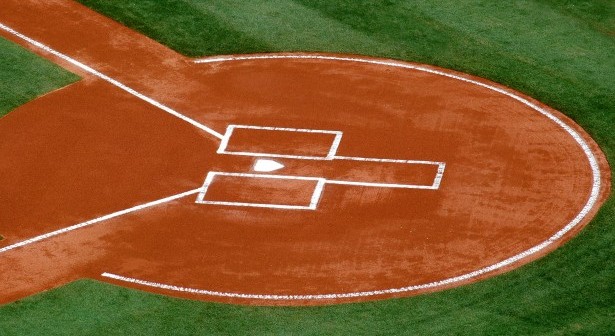
The batter’s box itself refers, as shown above, to the plate where the batter hits the baseball. The English expression Plate Appearance refers to the batter appearing at the plate, and when the batter finishes his turn at bat in any form, 1 is added. A batter who has finished a plate appearance necessarily belongs to one of the following three states.3
- He is put out.
- He reaches base and scores.
- He reaches base and is left on base.
The Difference Between Plate Appearances and At-Bats
To someone who does not know baseball well, both look like ‘타ㅅ’ (ta-s), which makes them one of the especially confusing records. Put simply,
- a plate appearance is the number of times a person stood there regardless of the bat, and
- an at-bat is the number of times the bat physically made contact with the ball.4
In baseball, there is no occasion to use the bat unless one stands in the batter’s box, so at-bats cannot be greater than plate appearances. If we call the beneficial case among those where the bat makes contact a hit, then the inequality in Theorem [2] holds. $$ \text{hits} \le \text{at-bats} \le \text{plate appearances} $$
We know that using concrete game situations as examples to make these records understood by a layperson who confuses plate appearances with at-bats is markedly less effective. Instead, we will try to understand the following records according to the inequality above.
- (1) 4 plate appearances, 3 at-bats, 3 hits: given four chances, he seized the chance three times and contributed to the offense all three times, so it is a good record.
- (2) 5 plate appearances, 1 at-bat, 2 hits: this means at least two balls flew off a single swing. Such a record cannot exist.
- (3) 5 plate appearances, 2 at-bats, 1 hit: given five chances, he seized the chance twice among them and got a hit once among those, a record that makes the inequality hold properly.
(4) 3 plate appearances, 0 at-bats, 0 hits: even though he was given three chances, he could not put a single swing on the ball and thus failed to contribute to the offense, a bad record.
https://www.mlb.com/glossary/standard-stats/plate-appearance ↩︎
https://www.koreabaseball.com/About/Committee/RecordRule.aspx ↩︎
Sacrifices are of course excluded, but that is not important in the context of the difference between plate appearances and at-bats. ↩︎