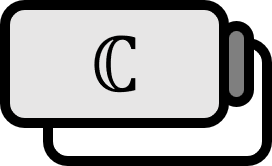
Proof of Cauchy's Theorem in Complex Analysis
Theorem1
Suppose that $f: A \subseteq \mathbb{C} \to \mathbb{C}$ is analytic on a simple closed path $\mathscr{C}$ and its interior, and that $f '$ is continuous. Then $$ \int_{\mathscr{C}} f(z) dz = 0 $$
Proof
For $a \le t \le b$, let $$ z(t) = x(t) + i y(t) \\ f(z) = u(x,y) + i v(x,y) $$ Then, since $\displaystyle {{dz} \over {dt}} = x ' + i y '$, $$ \begin{align*} f(z)dz =& f(z) ( x ' + i y ' ) dt \\ =& (u + i v ) ( x ' + i y ' ) dt \\ =& (u x ' - v y ' ) + i (v x ' + u y ' ) dt \end{align*} $$ Since $\displaystyle x ' = {{dx} \over {dt}}$ and $\displaystyle y ' = {{dy} \over {dt}}$, $$ \begin{align*} \int_{\mathscr{C}} f(z) dz =& \int_{a}^{b} (u x ' - v y ' ) dt + i \int_{a}^{b} (v x ' + u y ' ) dt \\ =& \int_{\mathscr{C}} (u dx - v dy ) + i \int_{\mathscr{C}} (v dx + u dy) \end{align*} $$ This is where the condition that the derivative is continuous is used.
Green’s theorem: If $P,Q$ are continuous and their derivatives are also continuous, then $$\int_{\mathscr{C}} (Pdx + Qdy) = \iint_{S} (Q_{x} - P_{y}) dx dy$$
By Green’s theorem, $$ \int_{\mathscr{C}} f(z) dz = - \iint_{S} (v_x + u_y) dxdy + i \iint_{S} (u_x - v_y) dxdy $$ Meanwhile, since $u,v$ are solutions satisfying the Cauchy-Riemann equations, we have $u_y = -v_x$ and $u_x = v_y$. Therefore $$ \int_{\mathscr{C}} f(z) dz = 0 $$
■
Explanation
In other words, when certain conditions are satisfied, there is no need to compute the definite integral at all. Cauchy may be the ‘father of analysis’, but as befits a theorem carrying his name alone, it is an extremely, truly important theorem. As you can see, satisfying the conditions on the function $f$ is not particularly difficult, so it can be put to use in many places.
Not only is it practical, but it is also remarkably simple, so one can even feel its mathematical beauty.
When handling the differentials and integrals, a hand-wavy style of analysis was used so that they can be understood intuitively, though not rigorously. The result happens to be the same, but the process is strictly speaking incorrect, so be careful.
One more useful theorem is introduced without proof.
Generalization
The Cauchy-Goursat Theorem
If $f$ is analytic on a simply connected region $\mathscr{R}$, then for a simple closed path $\mathscr{C}$ in the interior of $\mathscr{R}$, $$ \int_{\mathscr{C}} f(z) dz = 0 $$
The French mathematician Goursat achieved a generalization in the sense of removing the condition on the derivative of $f$. As a fact, it is clearly even more useful than Cauchy’s theorem, so be sure to remember it.
See Also
Osborne (1999). Complex variables and their applications: p82. ↩︎