
Integral Test
Introduction1
$$ \sum\limits_{n=1}^{\infty} \dfrac{1}{n^{2}} = 1 + \dfrac{1}{2^{2}} + \dfrac{1}{3^{2}} + \dfrac{1}{4^{2}} + \cdots $$
Suppose we are in a situation where we want to know whether a series like the one above converges or diverges. To this end, consider a function satisfying $\dfrac{1}{n^{2}} = f(n)$.
$$ f(x) = \dfrac{1}{x^{2}} $$
Along with the graph of the function $f(x)$, let us draw rectangles whose width is $1$ and whose height is the function value at the right endpoint of each interval.
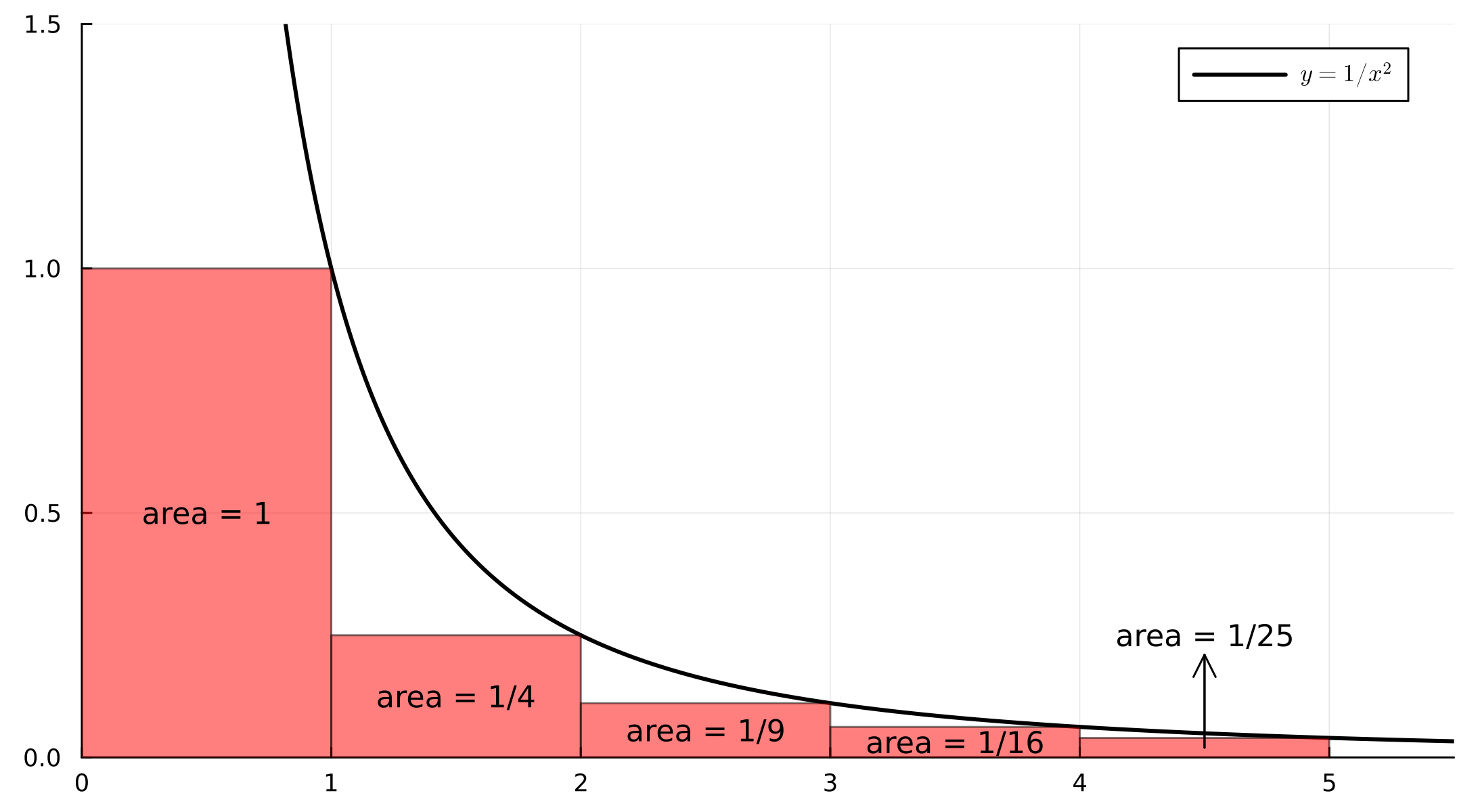
Then the sum of the areas of these rectangles equals the sum of the series we want to compute.
$$ \sum\limits_{n=1}^{\infty} \dfrac{1}{n^{2}} = 1 + \dfrac{1}{4} + \dfrac{1}{9} + \dfrac{1}{16} + \cdots $$
However, as can be seen from the figure, since $f(x)$ is a decreasing function and $f(x) > 0$, the rectangles are always drawn below the graph of $f(x)$. In other words, the sum of the areas of the rectangles cannot exceed the integral of the function $f(x)$. Therefore, we obtain the following inequality.
$$ \sum\limits_{n=1}^{\infty} \dfrac{1}{n^{2}} = 1 + \dfrac{1}{4} + \dfrac{1}{9} + \dfrac{1}{16} + \cdots \le 1 + \int_{1}^{\infty} \dfrac{1}{x^{2}} dx $$
That is, if the integral $\displaystyle \int_{1}^{\infty} \dfrac{1}{x^{2}}dx$ converges, then the series $\displaystyle \sum\limits_{n=1}^{\infty} \dfrac{1}{n^{2}}$ will converge. From this, we obtain the following theorem.
Theorem
Let a function $f$ be continuous on $x \in [1, \infty)$, be a decreasing function, and satisfy $f(x) > 0$. And let $a_{n} = f(n)$. Then the series $\displaystyle \sum\limits_{n=1}^{\infty} a_{n}$ converges if and only if the integral $\displaystyle \int_{1}^{\infty} f(x)dx$ converges.
$$ \int_{1}^{\infty} f(x) dx \text{ is convergent} \iff \sum\limits_{n=1}^{\infty} a_{n} \text{ is convergent} $$
$$ \int_{1}^{\infty} f(x) dx \text{ is divergent} \iff \sum\limits_{n=1}^{\infty} a_{n} \text{ is divergent} $$
Generalization
Since the addition of finitely many terms does not affect the convergence of a series, for a natural number $k$ we can generalize as follows.
$$ \int_{k}^{\infty} f(x) dx \text{ is convergent} \iff \sum\limits_{n=k}^{\infty} a_{n} \text{ is convergent} $$
$$ \int_{k}^{\infty} f(x) dx \text{ is divergent} \iff \sum\limits_{n=k}^{\infty} a_{n} \text{ is divergent} $$
Proof
If we prove only the following two propositions, then by taking the contrapositive we can see that the theorem holds.
- If the integral converges, then the series converges.
- If the integral diverges, then the series diverges.
If the Integral Converges, Then the Series Converges
Suppose we are given a sequence $\left\{ a_{n} \right\}$ and a function $f(x)$ satisfying the conditions of the theorem. As in the Introduction, if we draw rectangles whose height is the function value at the right endpoint of each interval, we obtain the figure below. (This holds because $f$ is a decreasing function.)
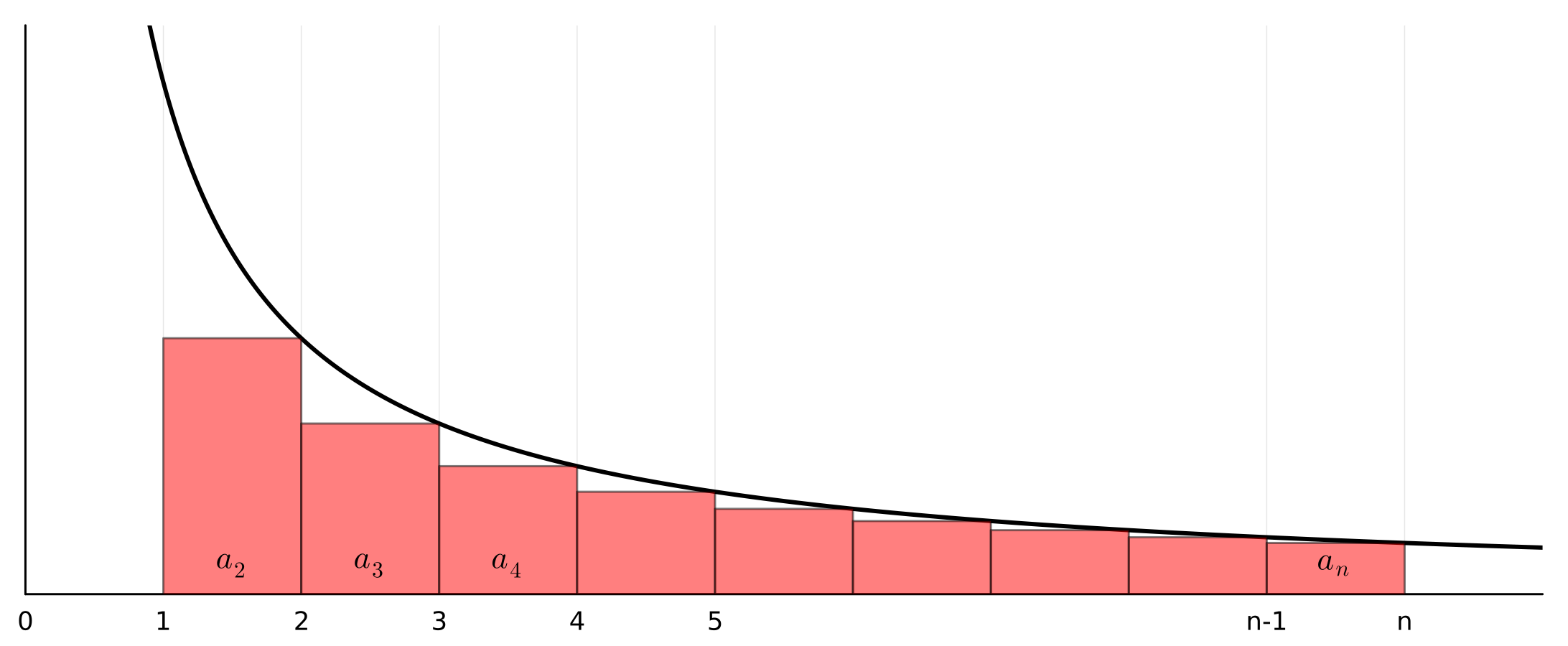
That is, the following expression holds.
$$ a_{2} + a_{3} + a_{4} + \cdots + a_{n} \le \int_{1}^{n} f(x) dx $$
If the integral $\displaystyle \int_{1}^{\infty} f(x) dx$ converges, then since $f > 0$,
$$ \sum\limits_{i=2}^{n} a_{n} \le \int_{1}^{n} f(x) dx \lt \int_{1}^{n} f(x) dx \lt \infty $$
Therefore, for the partial sum $s_{n}$ of the series, the following inequality holds.
$$ s_{n} = a_{1} + \sum\limits_{i=2}^{n} a_{n} \lt \int_{1}^{n} f(x) dx \lt \infty $$
This means that $s_{n}$ is bounded. Moreover, since $s_{n}$ is an increasing sequence, by the monotone sequence theorem, $s_{n}$ converges. That is, the series $\displaystyle \sum\limits_{n=1}^{\infty} a_{n}$ converges.
■
If the Integral Diverges, Then the Series Diverges
This time, let us draw rectangles whose height is the function value at the left endpoint of each interval.
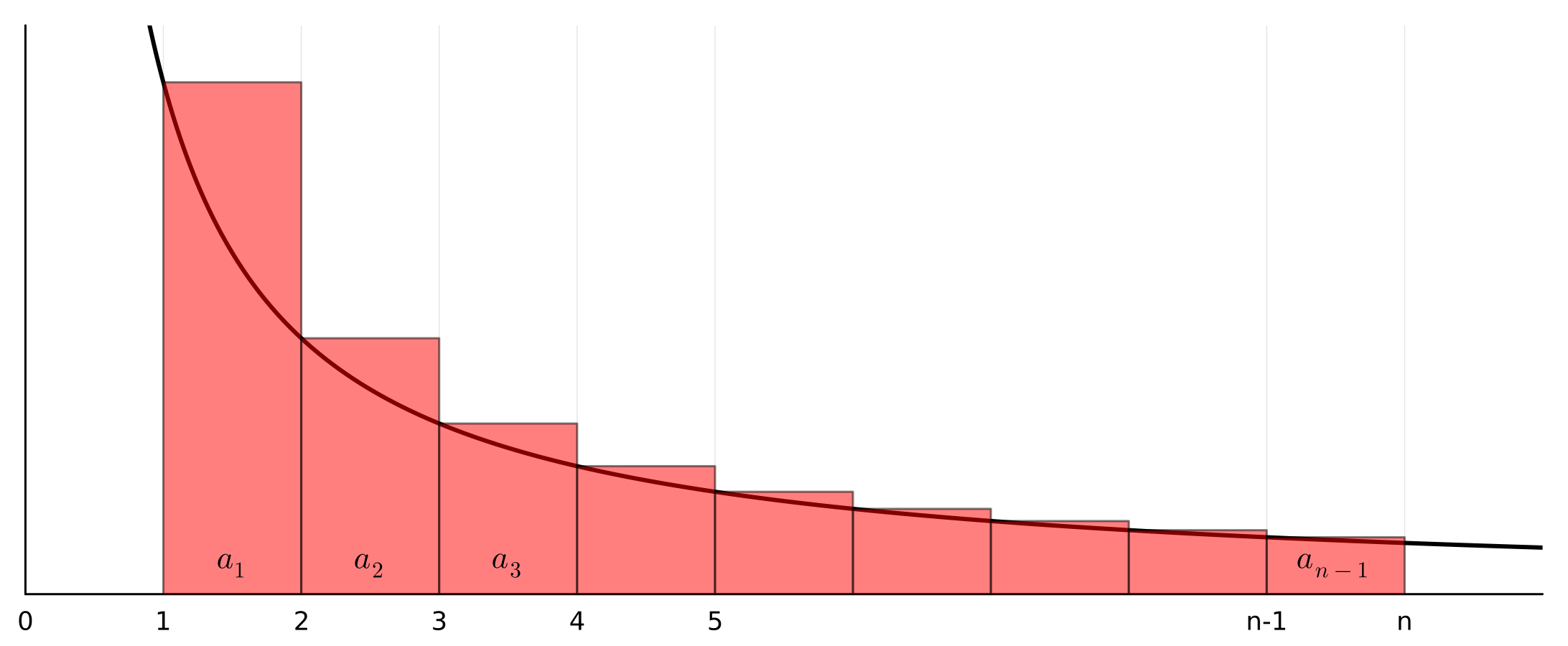
Therefore, the following expression holds.
$$ \int_{1}^{n} f(x) dx \le a_{1} + a_{3} + a_{4} + \cdots + a_{n} + a_{n+1} = \sum\limits_{i=1}^{n-1}a_{i} $$
$$ \implies \int_{1}^{n} f(x) dx \lt \sum\limits_{i=1}^{n-1}a_{i} $$
Taking the limit $n \to \infty$ on both sides,
$$ \int_{1}^{\infty} f(x) dx \lt \sum\limits_{i=1}^{\infty}a_{i} $$
Since the integral $\displaystyle \int_{1}^{\infty} f(x) dx$ diverges, the series $\displaystyle \sum\limits_{i=1}^{\infty}a_{i}$ diverges.
■
James Stewart, Daniel Clegg, and Saleem Watson, Calculus (early transcendentals, 9E), p751-758 ↩︎