함수열의 균등수렴과 적분가능성
Theorem1
Let the sequence of integrable functions $\left\{ f_{n} : f_{n} \text{ is integrable on } [a, b] \right\}$ on the interval $[a, b]$ converge uniformly on $[a, b]$ to $f$. $$ f_{n} \rightrightarrows f $$ Then $f$ is also integrable on $[a, b]$ and the following holds. $$ \int_{a}^{b} f dx = \lim\limits_{n \to \infty} \int_{a}^{b} f_{n} dx \tag{1} $$
Explanation2
In one phrase, the result of the theorem is “the integral of the limit equals the limit of the integrals.” In other words, it is permissible to interchange the limit operator and the integral operator.
$$ \int_{a}^{b} \lim\limits_{n \to \infty} f_{n} (x) dx = \lim\limits_{n \to \infty} \int_{a}^{b} f_{n} (x) dx $$
The reason we consider uniform convergence of a sequence of functions in relation to integration is that pointwise convergence does not preserve integrability. In other words, even if an integrable $f_{n}$ converges pointwise to $f$, that does not guarantee that $f$ is integrable. Or even if integrability is preserved, the integral values themselves may not coincide. Consider the following counterexample.
Counterexample
On the interval $[0, 1]$ there exist continuous functions $f_{n}$ and $f$ such that $f_{n} \to f$, but
$$ \lim\limits_{n \to \infty} \int_{0}^{1} f_{n} (x) dx \ne \int_{0}^{1} \left( \lim\limits_{n \to \infty} f_{n} (x) \right) dx $$
holds.
Proof
Let $f_{1}(x) = 1$. For $n \gt 1$, define $f_{n}$ so that its graph is a triangle with base length $\dfrac{2}{n}$ and height $n$ as follows. $$ f_{n}(x) = \begin{cases} n^{2}x & \text{if } 0 \le x \lt \frac{1}{n} \\ 2n - n^{2}x & \text{if } \frac{1}{n} \le x \le \frac{2}{n} \\ 0 & \text{if } \frac{2}{n} \lt x \le 1 \end{cases} $$
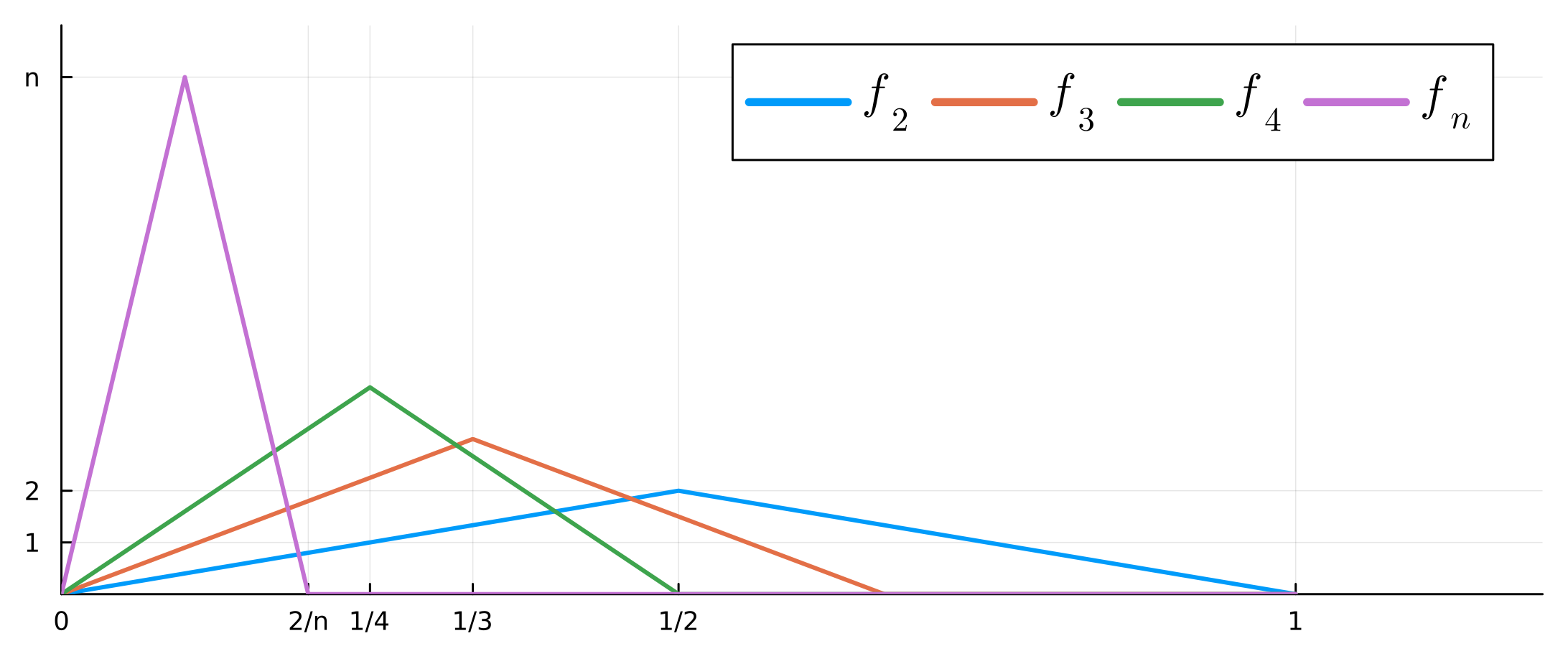
Since $f_{n}$ converges pointwise to $0$ on $[0, 1]$,
$$ \int_{0}^{1} \lim\limits_{n \to \infty} f_{n}(x) dx = \int_{0}^{1} 0 dx = 0 $$
However, the area of the triangle traced by the graph of $f_{n}$ is always $\dfrac{1}{2} \times \dfrac{2}{n} \times n = 1$, hence
$$ \lim\limits_{n \to \infty} \int_{0}^{1} f_{n}(x) dx = 1 $$
■
Proof
$f$ is integrable.
Assume $\varepsilon_{n} = \sup\limits_{x} \left| f_{n}(x) - f(x) \right|$; then the following holds.
$$ f_{n} - \varepsilon_{n} \le f \le f_{n} + \varepsilon_{n} $$
Then for the upper and lower Riemann integrals of $f$ the following is true.
$$ \implies \underline{\int} (f_{n} - \varepsilon_{n}) dx \le \underline{\int} f dx \le \overline{\int} f dx \le \overline{\int} (f_{n} + \varepsilon_{n}) dx $$
Since $f_{n}$ is integrable, $\displaystyle \left( \underline{\int} f_{n} = \int_{a}^{b} f_{n}= \overline{\int} f_{n} \right)$,
$$ \int_{a}^{b} (f_{n} - \varepsilon_{n}) dx \le \underline{\int} f dx \le \overline{\int} f dx \le \int_{a}^{b} (f_{n} + \varepsilon_{n}) dx \tag{2} $$
$$ \implies 0 \le \overline{\int} f dx - \underline{\int} f dx \le \int_{a}^{b} 2\varepsilon_{n} dx = 2 \varepsilon_{n} (b-a) $$
Therefore $f_{n} \rightrightarrows f$, so it is $\lim\limits_{n \to \infty} \varepsilon_{n} = 0$. Hence the upper and lower integrals coincide, which means $f$ is Riemann integrable.
■
$(1)$ holds
Since $f$ is integrable, from $(2)$ we obtain
$$ \int_{a}^{b} f dx \le \int_{a}^{b} f_{n} + \varepsilon_{n} dx $$
$$ \implies \left| \int_{a}^{b} f dx - \int_{a}^{b} f_{n} dx \right| \le \varepsilon_{n} (b-a) $$
Because $\lim\limits_{n \to \infty} \varepsilon_{n} = 0$, it follows that $\lim\limits_{n \to \infty} \int_{a}^{b} f_{n} dx = \int_{a}^{b} f dx$.
■