
Zeeman Effect
Explanation
This is a phenomenon discovered in 1897 by the Dutch physicist Pieter Zeeman, referring to the splitting of the emission spectral lines when an atom is placed in a magnetic field.
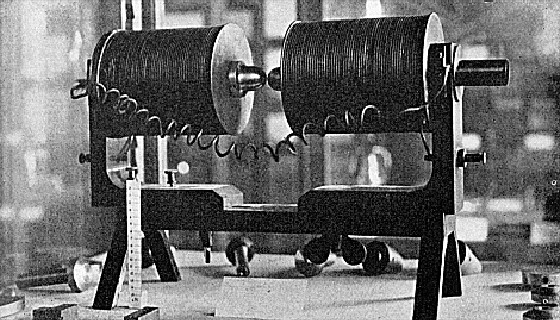
In 1860, Faraday conducted research on the spectrum of sodium and magnetic fields, but obtained no notable results. Later, Zeeman also carried out the same research but likewise obtained no new results, and forgot about it for a while. Then Zeeman, who often gained inspiration from reading Faraday’s books, learned that Faraday had done the same experiment, and began his research again with precise experimental instruments. In August 1896, Zeeman conducted an experiment observing the radiation emitted by placing asbestos coated with salt into a flame between electromagnets. He found that when the electromagnets were on, that is, when an external magnetic field was present, the line spectrum of sodium appeared broadened. He also learned that Ernst Pringsheim had already reported the same phenomenon in 1892. Zeeman then grew skeptical about whether this effect was truly caused by the magnetic field, and conducted more precise experiments. The photograph below shows the electromagnet that Zeeman actually used in his experiments.
Afterward, Zeeman became convinced that magnetic fields affect the spectral lines of atoms, and spoke about this at the Royal Netherlands Academy of Arts and Sciences. Upon hearing this, Lorentz said that his own radiation theory could explain the phenomenon Zeeman had discovered. In Lorentz’s radiation theory, it is assumed that within all matter there exist small electrically charged particles named Ions of Electrolysis. In effect, he was thinking of something essentially the same as the electron before the existence of the electron had been established. Zeeman designed his experiments in even greater detail and continued them. In 1897, he used cadmium instead of sodium, and in fact confirmed that the spectral lines had not broadened but had split into several. The stronger the magnetic field, the more they split, which was a result that agreed well with Lorentz’s theory. In the photographs below, the top shows the sodium spectral lines when there is no magnetic field, and the bottom shows the sodium spectral lines when there is a magnetic field.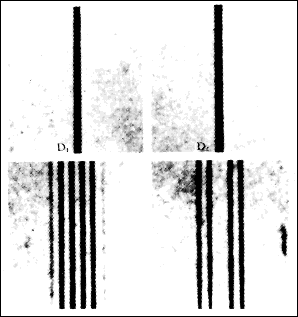 Thus, thanks to Zeeman’s contribution, the phenomenon in which the spectral lines of an atom split within a magnetic field came to be called the Zeeman Effect. Zeeman and Lorentz were awarded the Nobel Prize in Physics in 1902 for their work on the Zeeman effect. However, Lorentz’s theory could not explain all Zeeman effects; phenomena that could be explained by Lorentz’s theory came to be called the Normal Zeeman Effect, and phenomena that could not be explained came to be called the Anomalous Zeeman Effect. References123
이강영. (2018). 스핀: 파울리, 배타 원리 그리고 진짜 양자역학 ↩︎
https://ko.wikipedia.org/wiki/%EC%A0%9C%EC%9D%B4%EB%A7%8C%ED%9A%A8%EA%B3%BC ↩︎