
Ellipse
Definition
The set of points on a plane for which the sum of the distances to two points $F$, $F^{\prime}$ is constant is called an ellipse.
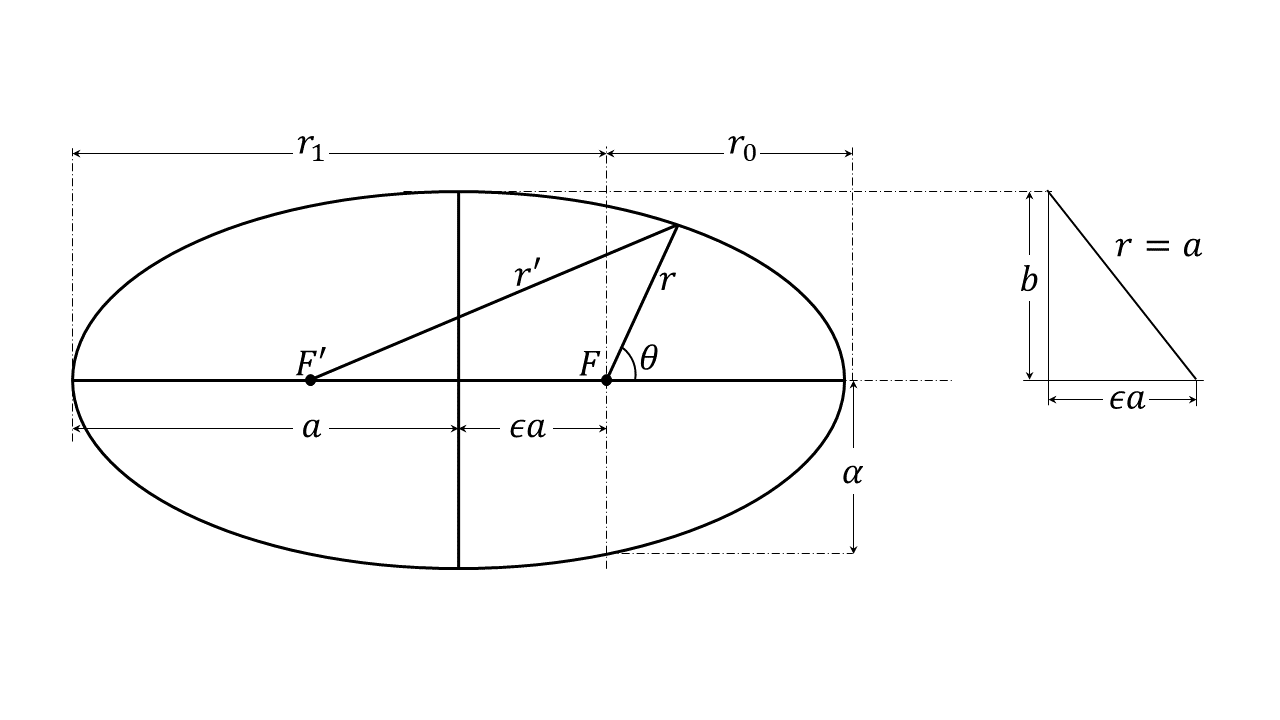
The components of an ellipse are as follows.
$F$, $F^{\prime}$ are called the focus.
$a$ is called the semimajor axis, and $b$ the semiminor axis. $b=\sqrt{1-\epsilon^{2}}a$ holds.
$\epsilon$ is called the eccentricity. It indicates how flattened the ellipse is, and the focus is located a distance $\epsilon a$ from the center of the ellipse. It is also denoted by $k$ or $e$.
$$ \epsilon^{2}=k^{2}=e^{2} =\begin{cases} \frac{a^{2}-b^{2}}{a^{2}} ,&0<b<a \\ \frac{b^{2}-a^{2}}{b^{2}}, &0<a<b \end{cases} $$
The distance $\alpha$ from the focus to the point where a line drawn from the focus perpendicular to the semimajor axis meets the ellipse is called the latus rectum. $\alpha = (1-\epsilon^{2})a$ holds.
$r_{0}$ is the distance from the focus to the pericenter, and $r_{0}=(1-\epsilon)a$ holds.
$r_{1}$ is the distance from the focus to the apocenter, and $r_{1}=(1+\epsilon)a$ holds.
Explanation
If the two foci coincide it is a circle, so ordinarily an ellipse means that the two foci are distinct.
Criterion
For a given conic $Ax^{2} + Bxy + Cy^{2} + Dx + Ey + F = 0$, $\Delta = B^{2} - 4AC$ is called the discriminant. A conic whose discriminant is negative is an ellipse.
Equation of an Ellipse
The equation of an ellipse whose center is $(x_{0}, y_{0})$ with semimajor axis $a$ and semiminor axis $b$ is as follows.
$$ \frac{(x-x_{0})^{2}}{a^{2}}+\frac{(y-y_{0})^{2}}{b^{2}}=1 $$
Equation of an Ellipse with a Focus at the Origin in Polar Coordinates
In polar coordinates, the equation of an ellipse is as follows.
$$ r = \frac{\alpha}{1+\epsilon \cos \theta} $$
or
$$ r = \frac{b^{2}/a}{1+\frac{\sqrt{a^{2}-b^{2}}}{a}\cos\theta} $$
Area of an Ellipse
The area $A$ of an ellipse with semimajor axis $a$ and semiminor axis $b$ is as follows.
$$ A=ab\pi $$
Perimeter of an Ellipse
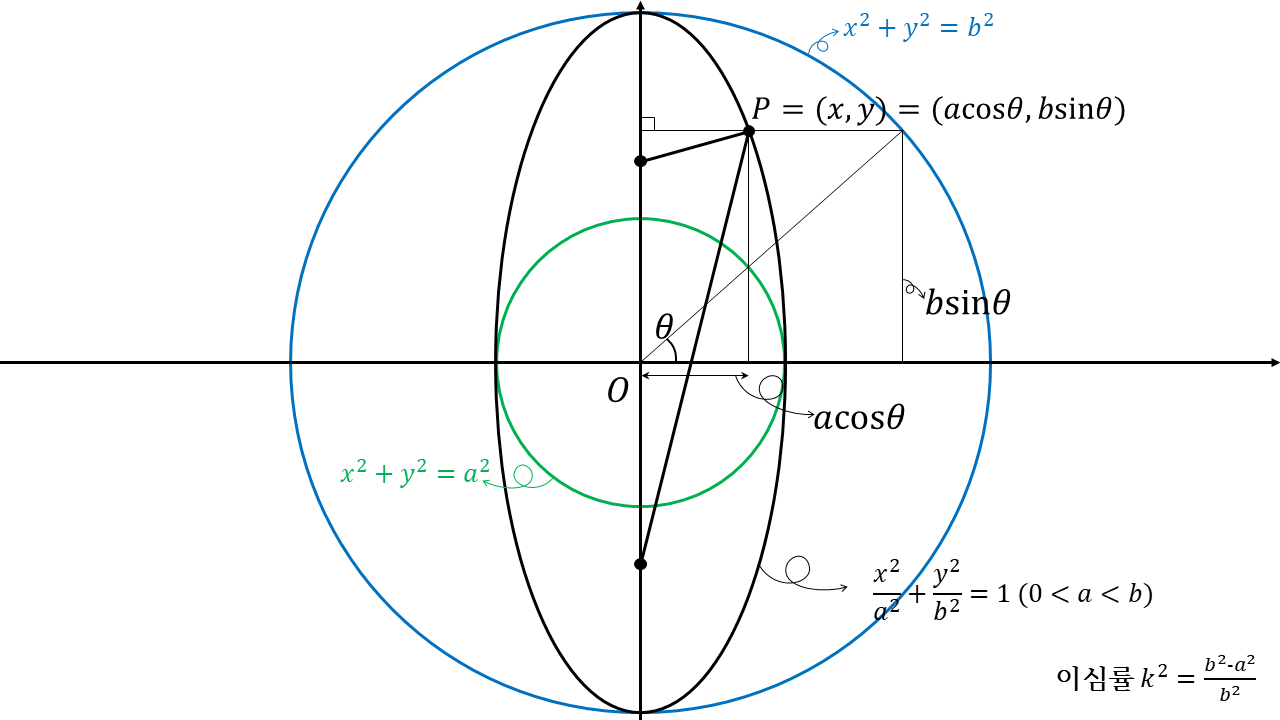
The perimeter of an ellipse as shown in the figure above is as follows.
$$ 4b\int _{0} ^{{\textstyle \frac{\pi}{2}}} \sqrt{ 1-k^{2}\sin^{2} \theta } d\theta ,\quad k^{2}=\frac{b^{2}-a^{2} }{b^{2}} $$
Elliptic Integral of the Second Kind
The integrals below are called the complete elliptic integral of the second kind and the incomplete elliptic integral of the second kind, respectively.
$$ E(k)=\int_{0}^{{\textstyle \frac{\pi}{2}}}\sqrt{1-k^{2} \sin ^{2} \theta} d\theta $$
$$ E(\phi, k)=\int_{0}^{\phi}\sqrt{1-k^{2} \sin ^{2} \theta}d\theta $$
Generalization of the Ellipse, Ellipsoid
For a linear transformation $A \in \mathbb{R}^{m \times m}$, the image $AN$ of the $m$-dimensional unit sphere $N := \left\{ \mathbf{x} \in \mathbb{R}^{m} : \left\| \mathbf{x} \right\|_{2} = 1 \right\}$ is called an ellipsoid. For the eigenvalues $\sigma_{1}^{2} > \cdots \ge \sigma_{m}^{2} \ge 0$ of $A$ and the corresponding unit eigenvectors $u_{1} , \cdots , u_{m}$, $\sigma_{i} u_{i}$ is called an axis of the ellipsoid.