
Velocity and Acceleration of a Particle in a Coordinate System
Formulas
$$ \begin{align*} \mathbf{v} &=\dot{r} \hat {\mathbf{r}} +r \dot{\theta} \hat{ \boldsymbol{\theta}}+ r \dot{\phi} \sin{\theta} \hat{ \boldsymbol{\phi}} \\ \mathbf{a} &= (\ddot{r}-r\dot\theta^2-r\dot\phi^2\sin^2\theta)\hat{\mathbf{r}}+(r\ddot\theta+2\dot{r}\dot\theta-r\dot\phi^2\sin\theta\cos\theta)\hat{\boldsymbol{\theta}} \\ &\quad+(r\ddot\phi\sin\theta+2\dot{r}\dot\phi\sin\theta+2r\dot\theta\dot\phi\cos\theta)\hat{\boldsymbol{\phi}} \end{align*} $$
Derivation
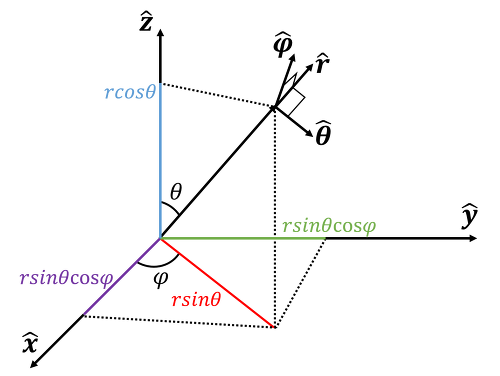
The unit vectors in spherical coordinates are as follows.
$$ \begin{align*} \hat{\mathbf{r}} &= \cos \phi \sin \theta \hat{\mathbf{x}} + \sin \phi \sin \theta \hat{\mathbf{y}} + \cos\theta\hat{\mathbf{z}} \\ \hat{\boldsymbol{\theta}} &= \cos\phi \cos\theta \hat{\mathbf{x}} + \sin\phi \cos\theta \hat{\mathbf{y}} - \sin\theta\hat{\mathbf{z}} \\ \hat{\boldsymbol{\phi}} &= -\sin\phi \hat{\mathbf{x}} + \cos\phi \hat{\mathbf{y}} \end{align*} $$
Let’s compute the velocity and acceleration in spherical coordinates. Velocity is obtained by differentiating the position with respect to time, and acceleration by differentiating the velocity with respect to time. For reference, $\dot{r}$ is read as “r dot”. In physics, a dot above a symbol denotes a time derivative.
$$ \dot{r}=\frac{dr}{dt} $$
Before computing velocity and acceleration, let’s precompute the derivatives of the unit vectors. Evaluating $\dot{\hat{ \mathbf{r}}}$, $\dot {\hat{ \boldsymbol{\theta}}}$, and $\dot {\hat{ \boldsymbol{\phi}}}$ yields respectively:
$$ \begin{align*} \dot{\hat{ \mathbf{r}}} &= \frac{d}{dt}(\cos\phi\sin\theta\hat{\mathbf{x}} +\sin\phi\sin\theta\hat{\mathbf{y}}+\cos\theta\hat{\mathbf{z}} ) \\ &= \frac{d\cos\phi}{dt}\sin\theta\hat{\mathbf{x}} + \cos\phi\frac{d \sin\theta}{dt}\hat{\mathbf{x}}+\frac{d \sin\phi}{dt}\sin\theta\hat{\mathbf{y}} + \sin\phi\frac{d\sin\theta}{dt}\hat{\mathbf{y}}+\frac{d \cos\theta}{dt}\hat{\mathbf{z}} \\ &= \frac{d\cos\phi}{d\phi}\frac{d\phi}{dt}\sin\theta\hat{\mathbf{x}} + \cos\phi\frac{d \sin\theta}{d\theta}\frac{d\theta}{dt}\hat{\mathbf{x}} \\ &\quad +\frac{d \sin\phi}{d\phi}\frac{d\phi}{dt}\sin\theta\hat{\mathbf{y}} + \sin\phi\frac{d\sin\theta}{d\theta}\frac{d\theta}{dt}\hat{\mathbf{y}}+ \frac{d \cos\theta}{d\theta}\frac{d\theta}{dt}\hat{\mathbf{z}} \\ &= -\dot\phi\sin\phi \sin\theta\hat{\mathbf{x}} + \dot\theta\cos\phi\cos\theta\hat{\mathbf{x}}+\dot\phi\cos\phi \sin\theta\hat{\mathbf{y}} + \dot\theta\sin\phi\cos\theta\hat{\mathbf{y}}-\dot\theta\sin\theta\hat{\mathbf{z}} \\ &= \dot{\theta}(\cos\phi\cos\theta\hat{\mathbf{x}} + \sin\phi\cos\theta\hat{\mathbf{y}} -\sin\theta \hat{\mathbf{z}}) + \dot{\phi}\sin\theta (-\sin\phi\hat{\mathbf{x}}+\cos\phi\hat{\mathbf{y}}) \\ &= \dot{\theta} \hat{ \boldsymbol{\theta} } + \dot{\phi} \sin\theta \hat{ \boldsymbol{\phi}} \end{align*} $$
$$ \begin{align*} \dot {\hat{ \boldsymbol{\theta}}} &= \frac{d}{dt}(\cos\phi\cos\theta\hat{\mathbf{x}} + \sin\phi\cos\theta\hat{\mathbf{y}} -\sin\theta \hat{\mathbf{z}}) \\ &= -\dot{\phi}\sin\phi\cos\theta\hat{\mathbf{x}}-\dot\theta\cos\phi\sin\theta\hat{\mathbf{x}}+\dot{\phi} \cos\phi \cos\theta \hat{\mathbf{y}}-\dot{\theta} \sin\phi \sin\theta \hat{\mathbf{y}}-\dot\theta\cos\theta\hat{\mathbf{z}} \\ &= -\dot\theta (\cos\phi\sin\theta\hat{\mathbf{x}}+\sin\phi\sin\theta \hat{\mathbf{y}} + \cos\theta\hat{\mathbf{z}}) + \dot{\phi}\cos\theta (-\sin\phi\hat{\mathbf{x}}+\cos\phi\hat{\mathbf{y}}) \\ &= - \dot{\theta} \hat{ \mathbf{r}} + \dot{\phi} \cos \theta \hat {\boldsymbol{\phi}} \end{align*} $$
$$ \begin{equation} \begin{aligned} \dot {\hat{ \boldsymbol{\phi}}} &= \frac{d}{dt}(-\sin\phi\hat{\mathbf{x}}+\cos\phi\hat{\mathbf{y}}) \\ &= -\dot\phi\cos\phi\hat{\mathbf{x}}-\dot\phi\sin\phi\hat{\mathbf{y}} \\ &= -\dot\phi (\cos\phi\hat{\mathbf{x}} + \sin\phi\hat{\mathbf{y}}) \end{aligned} \end{equation} $$
The result $\dot {\hat{\boldsymbol{\phi}}}$, unlike the other components, does not immediately simplify into $\hat{\mathbf{r}}$ and $\hat{\boldsymbol{\theta}}$. If you look closely, you can see that there is no $\hat{\mathbf{z}}$ component. If you multiply $\hat{\mathbf{r}}$ by $\sin\theta$ and $\hat{\boldsymbol{\theta}}$ by $\cos\theta$ and add them, the $\hat{\mathbf{z}}$ component disappears. Let’s use this.
$$ \begin{align*} \ \sin\theta\hat{\mathbf{r}}+\cos\theta \hat{\boldsymbol{\theta}} &= \cos\phi\sin^2\theta\hat{\mathbf{x}}+\sin\phi\sin^2\theta\hat{\mathbf{y}}+\sin\theta\cos\theta \hat{\mathbf{z}} \\ &\quad + \cos\phi\cos^2\theta\hat{\mathbf{x}} +\sin\phi\cos^2\theta\hat{\mathbf{y}} -\sin\theta\cos\theta \hat{\mathbf{z}} \\ &= \cos\phi (\sin^2\theta+\cos^2\theta)\hat{\mathbf{x}}+\sin\phi (\sin^2\theta+\cos^2\theta)\hat{\mathbf{y}} \\ &= \cos\phi\hat{\mathbf{x}}+\sin\phi\hat{\mathbf{y}} \end{align*} $$
Substituting the above into $(1)$ gives:
$$ \dot{\hat{\boldsymbol{\phi}}}=-\dot\phi\sin\theta\hat{\mathbf{r}} - \dot\phi\cos\theta \hat{\boldsymbol{\theta}} $$
Velocity
Differentiating $\mathbf{r}$ with respect to $t$ yields:
$$ \begin{align*} \mathbf{v} = \frac{d \mathbf{r}}{dt} = \frac{d}{dt}(r \hat{\mathbf{r}}) = \frac{d r}{dt}\hat{\mathbf{r}} + r\frac{d \hat{\mathbf{r}}}{dt} &= \dot{r} \hat{\mathbf{r}} + r \dot{\hat{\mathbf{r}}} \\ &= \dot{r} \hat{\mathbf{r}} + r\dot{\theta} \hat{ \boldsymbol{\theta} } + r\dot{\phi} \sin\theta \hat{ \boldsymbol{\phi}} \end{align*} $$
You just need to substitute the previously computed derivatives of the unit vectors to obtain it.
■
Acceleration
Differentiating $\mathbf{v}$ with respect to $t$ yields:
$$ \begin{align*} \mathbf{a} = \frac{d \mathbf{v}}{dt} &= \frac{d}{dt}(\dot{r} \hat{\mathbf{r}} +r\dot\theta\hat{\boldsymbol{\theta}}+ r\dot\phi\sin\theta \hat{\boldsymbol{\phi}}) \\ &= (\ddot r \hat{\mathbf{r}} + \dot{r} \dot{\hat{\mathbf{r}}}) + (\dot{r}\dot\theta\hat{\boldsymbol{\theta}} + r\ddot\theta\hat{\boldsymbol{\theta}} + r\dot\theta\dot{\hat{\boldsymbol{\theta}}}) \\ &\quad + (\dot{r} \dot\phi\sin\theta \hat{\boldsymbol{\phi}}+ r\ddot\phi\sin\theta\hat{\boldsymbol{\phi}}+ r\dot\phi\dot\theta\cos\theta\hat{\boldsymbol{\phi}}+ r\dot\phi\sin\theta\dot{\hat{\boldsymbol{\phi}}}) \end{align*} $$
It’s extremely long. Let’s work through it step by step. The derivatives of the unit vectors were calculated above, so substitute and simplify.
$$ \begin{align*} \mathbf{a} &= \left[ \ddot r \hat{\mathbf{r}} + \dot{r} (\dot{\theta} \hat{\boldsymbol{\theta}} + \dot{\phi} \sin\theta \hat{\boldsymbol{\phi}}) \right] + \left[ \dot{r}\dot\theta\hat{\boldsymbol{\theta}}+ r\ddot\theta\hat{\boldsymbol{\theta}}+r\dot\theta ( -\dot{\theta} \hat{\mathbf{r}} + \dot{\phi} \cos \theta \hat{\boldsymbol{\phi}}) \right] \\ &\quad + \left[ \dot{r} \dot\phi\sin\theta\hat{\boldsymbol{\phi}}+ r\ddot\phi\sin\theta\hat{\boldsymbol{\phi}}+ r\dot\phi\dot\theta\cos\theta\hat{\boldsymbol{\phi}}+ r\dot\phi\sin\theta (-\dot\phi\sin\theta\hat{\mathbf{r}} - \dot\phi\cos\theta\hat{\boldsymbol{\theta}}) \right] \\ &= (\ddot{r}-r\dot\theta^2-r\dot\phi^2\sin^2\theta)\hat{\mathbf{r}}+(r\ddot\theta+2\dot{r}\dot\theta-r\dot\phi^2\sin\theta\cos\theta)\hat{\boldsymbol{\theta}} \\ &\quad +(r\ddot\phi\sin\theta+2\dot{r}\dot\phi\sin\theta+2r\dot\theta\dot\phi\cos\theta)\hat{\boldsymbol{\phi}} \end{align*} $$
■