
Velocity and Acceleration of a Particle in Cylindrical Coordinates
Formulas
$$ \begin{align*} \mathbf{v}&=\dot{r} \hat{\mathbf{r}} + r \dot{\phi} \hat{\boldsymbol{\phi}}+\dot{z} \hat{\mathbf{z}} \\ \mathbf{a} &= (\ddot r -r\dot{\phi} ^2)\hat{\mathbf{r}} + (2\dot{r} \dot{\phi} + r\ddot{\phi})\hat{\boldsymbol{\phi}} + \ddot{z}\hat{\mathbf{z}} \end{align*} $$
Derivation
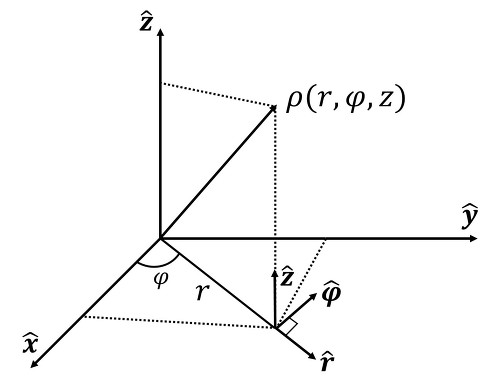
The unit vectors in cylindrical coordinates are as follows.
$$ \begin{align*} \boldsymbol{\rho}&=x\hat{\mathbf{x}}+y \hat{\mathbf{y}} +z\hat{\mathbf{z}}=r\hat{\mathbf{r}} +z\hat{\mathbf{z}} \\ \hat{\mathbf{r}} &= \hat{\mathbf{r}}(\phi) = \cos\phi \hat{\mathbf{x}} + \sin\phi \hat{\mathbf{y}} \\ \hat{\boldsymbol{\phi}} &= \hat{\mathbf{r}}(\phi+\pi/2) = -\sin\phi \hat{\mathbf{x}} + \cos\phi \hat{\mathbf{y}} \\ \hat{\mathbf{z}} &= \hat{\mathbf{z}} \end{align*} $$ The velocity is obtained by differentiating position with respect to time, and the acceleration is obtained by differentiating velocity with respect to time. Note that $\dot{r}$ is read as “a dot.” In physics, a dot above a letter denotes differentiation with respect to time.
$$ \dot{r} = \frac{dr}{dt} $$
Velocity
Differentiating $\boldsymbol{\rho}$ with respect to $t$ gives:
$$ \begin{align*} \mathbf{v}&=\frac{d \boldsymbol{\rho}}{dt} \\ &=\frac{d}{dt}(r \hat{\mathbf{r}}+z\hat{\mathbf{z}}) \\ &=\frac{d r}{dt}\hat{\mathbf{r}} + r\frac{d \hat{\mathbf{r}}}{dt} +\frac{dz}{dt}\hat{\mathbf{z}} +z\frac{d \hat{\mathbf{z}}}{dt} \\ &=\dot{r} \hat{\mathbf{r}} +r \dot{\hat {\mathbf{r}}}+\dot{z} \hat{\mathbf{z}} \end{align*} $$
Here the unit vectors of the Cartesian coordinate system do not change with time. In other words:
$$ \dot{\hat{\mathbf{x}}}=\dot{\hat{\mathbf{y}}}=\dot{\hat{\mathbf{z}}} = \mathbf{0} $$
Computing $\dot{\hat{\mathbf{r}}}$ yields:
$$ \begin{align*} \dot{\hat {\mathbf{r}}} = \frac{d}{dt}(\hat{\mathbf{r}}) &= \frac{d}{dt}(\cos\phi \hat{\mathbf{x}}) + \frac{d}{dt}(\sin\phi \hat{\mathbf{y}}) \\ &= \frac{d\cos\phi}{dt}\hat{\mathbf{x}} + \frac{d\sin\phi}{dt}\hat{\mathbf{y}} \\ &= \frac{d\cos\phi}{d \phi}\frac{d \phi}{dt}\hat{\mathbf{x}}+\frac{d\sin\phi}{d \phi}\frac{d \phi}{dt}\hat{\mathbf{y}} \\ &= -\sin\phi \frac{d \phi}{dt}\hat{\mathbf{x}}+\cos\phi \frac{d \phi}{dt}\hat{\mathbf{y}} \\ &= \frac{d \phi }{dt}(-\sin\phi \hat{\mathbf{x}}+\cos\phi \hat{\mathbf{y}}) \\ &= \dot{\phi} \hat{\boldsymbol{\phi}} \end{align*} $$
Therefore the velocity is:
$$ \mathbf{v}=\dot{r} \hat{\mathbf{r}} + r \dot{\phi} \hat{\boldsymbol{\phi}}+\dot{z} \hat{\mathbf{z}} $$
■
Acceleration
Differentiating $\mathbf{v}$ with respect to time and applying $t$ gives:
$$ \begin{align*} \mathbf{a}=\frac{d \mathbf{v}}{dt} &= \frac{d}{dt}(\dot{r} \hat{\mathbf{r}} + r \dot{\phi} \hat{\boldsymbol{\phi}} +\dot{z} \hat{\mathbf{z}}) \\ &= \ddot r \hat{\mathbf{r}} +\dot{r} \dot{ \hat{\mathbf{r}}} + \dot{r} \dot{\phi} \hat{\boldsymbol{\phi}} + r \ddot{\phi} \hat{\boldsymbol{\phi}} + r \dot{\phi} \dot{ \hat{\boldsymbol{\phi}}} +\ddot{z}\hat{\mathbf{z}} \end{align*} $$
Evaluating $\dot{\hat{\boldsymbol{\phi}}}$ yields:
$$ \begin{align*} \dot{ \hat{\boldsymbol{\phi}}} = \frac{d}{dt}(\hat{\boldsymbol{\phi}}) &= \frac{d}{dt}(-\sin\phi \hat{\mathbf{x}})+\frac{d}{dt}(\cos\phi \hat{\mathbf{y}}) \\ &= -\frac{d\sin\phi}{dt}\hat{\mathbf{x}} +\frac{d\cos\phi}{dt}\hat{\mathbf{y}} \\ &= -\frac{d\sin\phi}{d \phi}\frac{d \phi}{dt}\hat{\mathbf{x}}+\frac{d\cos\phi}{d \phi}\frac{d \phi}{dt}\hat{\mathbf{y}} \\ &= \dfrac{d\phi}{dt} (-\cos\phi \hat{\mathbf{x}}-\sin\phi \hat{\mathbf{y}}) \\ &= - \dot{\phi} \hat{\mathbf{r}} \end{align*} $$
Thus, substituting and simplifying gives:
$$ \begin{align*} \mathbf{a} &= \ddot r \hat{\mathbf{r}} +\dot{r} \dot{ \hat{\mathbf{r}}} + \dot{r} \dot{\phi} \hat{\boldsymbol{\phi}} + r \ddot{\phi} \hat{\boldsymbol{\phi}} + r \dot{\phi} \dot{ \hat{\boldsymbol{\phi}}} +\ddot{z}\hat{\mathbf{z}} \\ &= \ddot r \hat{\mathbf{r}} +\dot{r} \dot{\phi}\hat{\boldsymbol{\phi}} + \dot{r} \dot{\phi} \hat{\boldsymbol{\phi}} + r \ddot{\phi} \hat{\boldsymbol{\phi}} -r \dot{\phi} \dot{\phi} \hat{\mathbf{r}} +\ddot{z}\hat{\mathbf{z}} \\ &= (\ddot r -r\dot{\phi} ^2)\hat{\mathbf{r}} + (2\dot{r} \dot{\phi} + r\ddot{\phi})\hat{\boldsymbol{\phi}} +\ddot{z}\hat{\mathbf{z}} \end{align*} $$
■
Because cylindrical coordinates are just polar coordinates with the added height $z$, the formulas for velocity and acceleration are those in polar coordinates with only the additional $\dot{z} \hat{\mathbf{z}}$ and $\ddot{z}\hat{\mathbf{z}}$ terms, respectively.