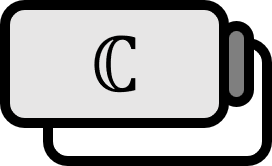
Relationship Between Trigonometric and Hyperbolic Functions in Complex Analysis
Definition 1
Let us define the hyperbolic functions $\sinh, \cosh : \mathbb{C} \to \mathbb{C}$ as complex functions as follows. $$ \sinh z := { {e^{z} - e^{-z}} \over 2 } \\ \cosh z := { {e^{z} + e^{-z}} \over 2 } $$
Theorem 2
$$ \begin{align*} \sinh (iz) =& i \sin z \\ \sin (iz) =& i \sinh z \\ \cosh (iz) =& \cos z \\ \cos (iz) =& \cosh z \end{align*} $$
Explanation
When first encountering hyperbolic functions, the most puzzling thing is precisely the question of ‘why such a definition is used’. On the real numbers, trigonometric functions are defined by the trigonometric ratios of the unit circle, while hyperbolic functions appear as linear combinations of exponential functions; from the definitions alone, it is hard to accept why hyperbolic functions are called a kind of trigonometric function. Only by viewing these functions on the complex numbers can one appreciate how well-structured and intuitive this system is.
The properties above also share some context with the properties originally used for trigonometric functions.
The Sine Function Is an Odd Function, the Cosine Function Is an Even Function
$$ \sin (-\theta) = - \sin \theta \\ \cos (-\theta) = \cos \theta $$
Just as $-1$ moves freely in and out of $\sin$ and has no effect on $\cos$, $i$ moves freely in and out of $\sin$ and $\sinh$ and has no effect on $\cos$ and $\cosh$. The difference is that, whether for $\sin$ or $\cos$, the state of the $\text{h}$ being attached or detached is flipped. If we consider that the complex numbers took the distinction between negative and positive and created the world of $i$ and $-i$, which is neither negative nor positive, then trigonometric functions too need $\sinh$ and $\cosh$ beyond the question of whether it is $\sin$ or $\cos$.
Periodicity of Hyperbolic Functions
$$ \sinh (ix) = i \sin x \\ \cosh (ix) = \cos x $$
Meanwhile, from the relationship between trigonometric and hyperbolic functions, one can easily verify that hyperbolic functions have periodicity along the pure imaginary numbers. It can be figured out quickly with a little thought, but when one is not familiar with this property, it is hard to realize on one’s own.
Proof
Trigonometric functions in complex analysis: $$ \sin z = { {e^{iz} - e^{-iz}} \over 2 i } \\ \cos z = { {e^{iz} + e^{-iz}} \over 2 } $$
$$ \sinh (iz) = { { e^{iz} - e^{-iz} } \over 2 } = i { { e^{iz} - e^{-iz} } \over {2 i} } = i \sin z $$
$$ \sin (iz) = { {e^{iiz} - e^{-iiz}} \over 2 i } = - i { {e^{-z} - e^{z}} \over 2 } = i \sinh z $$
$$ \cosh (iz) = { { e^{iz} + e^{-iz} } \over 2 } = \cos z $$
$$ \cos (iz) = { { e^{iiz} + e^{-iiz} } \over 2 } = { { e^{-z} + e^{z} } \over 2 } = \cosh z $$
■