
Steady Current and Biot-Savart Law
Definition1
Steady current refers to a flow of charge that continues indefinitely without change in magnitude or direction of travel.
Explanation
Because the current does not vary in time, the magnetic field produced by a steady current also does not vary in time. The term ‘direction of travel’ used here is a concept different from the usual notion of the direction of a vector. It does not mean the current must flow in a straight line; even if the conductor is curved, as long as the current continues only in one sense along it, the direction of travel is not changed. Let the volume charge density be $\rho$ and the volume current density be $\mathbf{J}$. If the current produced by these is a steady current, then by definition the following equation holds.
$$ \dfrac{\partial \rho}{\partial t} = 0 \quad \text{and} \quad \dfrac{\partial \mathbf{J}}{\partial t}=0 $$
Therefore, by the continuity equation the following holds.
$$ \nabla \cdot \mathbf{J} = 0 $$
Of course, steady current is an idealization and does not actually exist, so discussion of steady currents is entirely theoretical. Nevertheless, in many areas of physics these theories approximate reality quite well. The magnetic field produced by steady currents follows the law below, which is the fundamental law of magnetostatics corresponding to Coulomb’s law in electrostatics.
Law
A steady current produces a magnetic field. The magnitude and direction of the magnetic field induced by a steady current follow the law below, called the Biot–Savart law.
- It is proportional to the current magnitude $I$.
- It is proportional to the infinitesimal length of the wire $dl$.
- With respect to the angle between the direction of the infinitesimal current element and the separation vector $\theta$, it is proportional to $\sin\theta$.
- It is inversely proportional to the square of the distance $\cR^{2}$.
- Its direction is determined by the right-hand rule with respect to the direction of the infinitesimal current and the observation point, as in $d\mathbf{l} \times \crH$.
Formula
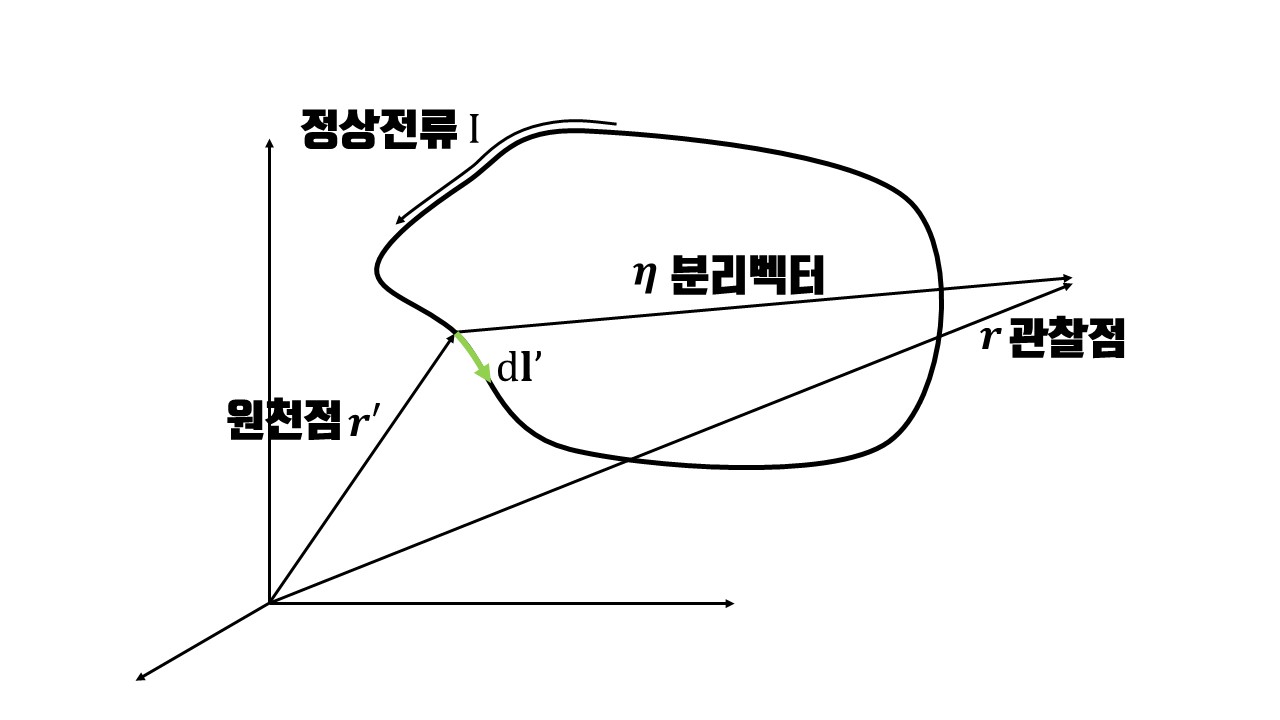
The magnetic field produced by a steady current can be calculated by the following expression.
$$ \mathbf{B}(\mathbf{r})=\dfrac{ \mu_{0}}{4\pi}\int \dfrac{\mathbf{I} \times \crH}{\cR ^2}dl^{\prime}=\dfrac{ \mu_{0}}{4\pi} I \int \dfrac{d \mathbf{l}^{\prime} \times \crH}{\cR ^2} $$
Here $\bcR$ is the separation vector, the constant $\mu$ is the permeability, and $\mu_{0}$ is the permeability of free space. The Biot–Savart law for surface currents and volume currents is written using the surface current density and the volume current density.
$$ \begin{align*} \mathbf{B}(\mathbf{r}) =&\ \dfrac{ \mu_{0}}{4\pi}\int \dfrac{\mathbf{K}(\mathbf{r}^{\prime}) \times \crH}{\cR ^2}da^{\prime} \\ \mathbf{B}(\mathbf{r}) =&\ \dfrac{ \mu_{0}}{4\pi}\int \dfrac{\mathbf{J}(\mathbf{r}^{\prime}) \times \crH}{\cR ^2}d\tau^{\prime} \end{align*} $$
Example
Find the magnetic field at a point a perpendicular distance $s$ from a wire carrying a steady current $I$.
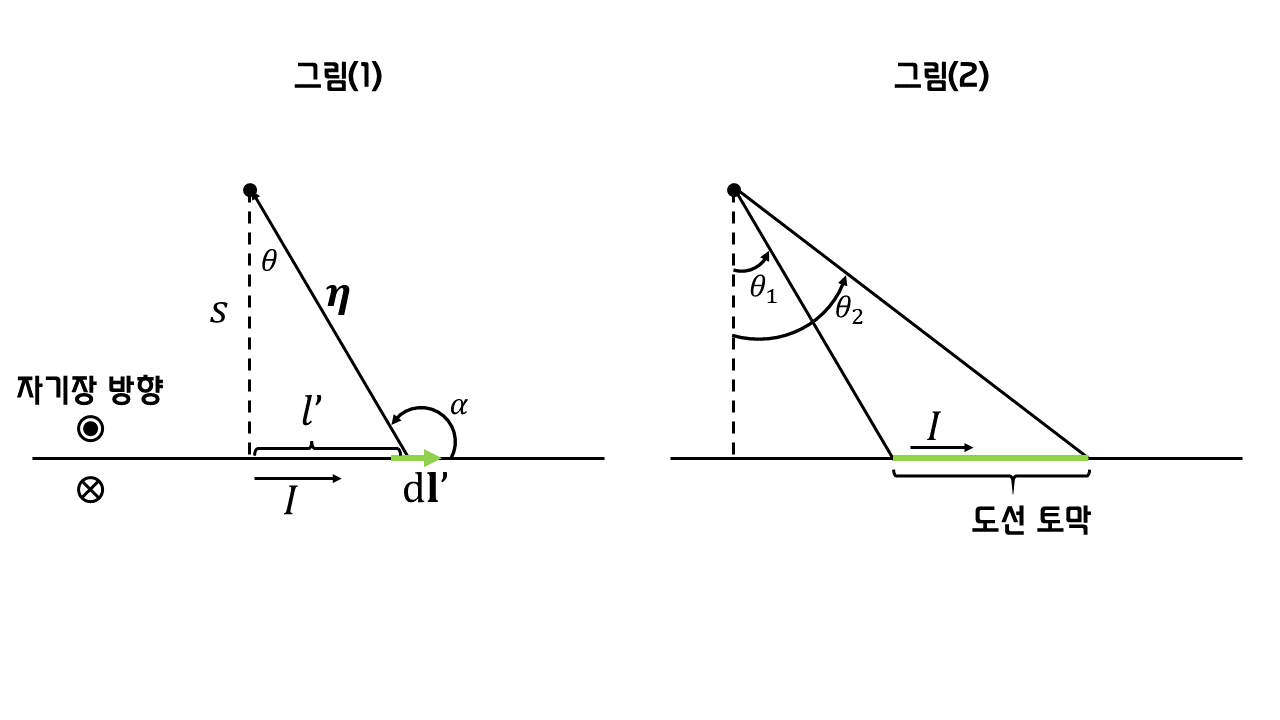
$$ \begin{align*} |d\mathbf{l}^{\prime} \times \crH | =&\ |d\mathbf{l}^{\prime}||\crH|\sin \alpha \\ =&\ dl^{\prime} \sin \alpha \\ =&\ dl^{\prime} \sin \left( \theta + \frac{\pi}{2} \right) \\ =&\ dl^{\prime} \cos \theta \end{align*} $$
Since $l^{\prime}=s\tan \theta$,
$$ dl^{\prime}=\dfrac{s}{\cos ^2 \theta}d\theta $$
and since $s=\cR \cos \theta$,
$$ \dfrac{1}{\cR ^2}=\dfrac{\cos ^2 \theta}{s^2} $$
Substituting this into the Biot–Savart law and computing the magnitude in $\mathbf{B}(\mathbf{r})$ gives
$$ \begin{align*} B =&\ \left| \dfrac{ \mu_{0}}{4\pi} I \int \dfrac{d \mathbf{l}^{\prime} \times \crH}{\cR ^2} \right| \\ =&\ \dfrac{ \mu_{0}}{4\pi} I \int \dfrac{ \left| d \mathbf{l}^{\prime} \times \crH \right| }{\cR ^2} \\ =&\ \dfrac{\mu_{0} I}{4\pi} \int \left( \dfrac{\cos ^2 \theta}{s^2} \right) \left( \dfrac{s}{\cos^2\theta} \right) \cos \theta d\theta \\ =&\ \dfrac{\mu_{0} I}{4\pi s} \int \cos \theta d\theta \end{align*} $$
If we were dealing with a finite segment of wire as in figure $(2)$, the integration limits would be from $\theta _{1}$ to $\theta_2$. The example concerns an infinitely long wire, so it corresponds to the case in figure $(2)$ with $\theta_{1}=-\dfrac{\pi}{2}$ and $\theta_2=\dfrac{\pi}{2}$. Therefore the magnitude of the magnetic field is
$$ \begin{align*} B =&\ \dfrac{\mu_{0} I}{4\pi s} \int_{-\frac{\pi}{2} }^{\frac{\pi}{2}} \cos \theta d\theta \\ =&\ \dfrac{\mu_{0} I}{4\pi s} \left(\sin {\textstyle \frac{\pi}{2}}- \sin {\textstyle \frac{-\pi}{2}} \right) \\ =&\ \dfrac{\mu_{0} I}{2\pi s} \end{align*} $$
The direction, by the right-hand rule, is out of the page. If the azimuthal direction to the right is taken as $\hat{\mathbf{z}}$ in cylindrical coordinates, then
$$ \mathbf{B}=\dfrac{\mu_{0} I}{2\pi s} \hat{\boldsymbol{\phi}} $$
■
David J. Griffiths, 기초전자기학 (Introduction to Electrodynamics, trans. 김진승) (4th Edition, 2014), p241-245 ↩︎