group Actions
Definition 1
Let $G$ be a group whose identity element is $e$, and let $X$ be a set. A $\ast : G \times X \to X$ on $X$ by $G$ that satisfies the following two conditions is called an action of $G$ on $X$, and $X$ is called a $G$-set.
- (i): For all $x \in X$, $ex = x$
- (ii): For all $x \in X$ and $g_{1} , g_{2} \in G$, $( g_{1} g_{2} ) (x) = g_{1} (g_{2} x)$
Explanation
An action of a group can be described in one phrase as “apply $g \in G$ to $x \in X$.” For an intuitively clear example, consider the following figure:
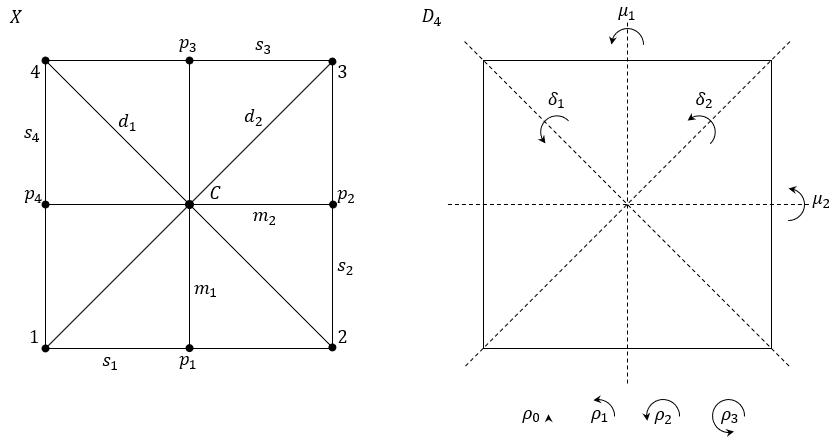
$$ X : = \left\{ C, 1,2,3,4 , p_{1}, p_{2} , p_{3} , p_{4} , s_{1}, s_{2} , s_{3} , s_{4} , d_{1}, d_{2} , m_{1} , m_{2} \right\} $$ Consider the set $X$ above and the dihedral group $D_{4}$. The set $X$, consisting of the segments and points one can imagine in a square, can be moved by the flips and rotations in $D_{4}$, so it is a $D_{4}$-set. It is quite natural and reasonable to call such operations that change $X$ an action.
Note that $X$ need not itself be a group nor have any relation to $G$. For example, considering $\mathbb{Z}$ and $$ X:= \left\{ \cdots , - {{3} \over {2}} , - {{1} \over {2}}, {{1} \over {2}} , {{3} \over {2}} , \cdots \right\} $$ we see that $\left< X , + \right>$ is not a group and has no relation with $G = \mathbb{Z}$ yet. However, if for $z \in \mathbb{Z}$ and $x \in X$ we define $\ast : \mathbb{Z} \times X \to X$ to be $ z * x = z + x$, then
- (i): $0 + x = x$, and
- (ii): $(z_{1} + z_{2}) + x = z_{1} + (z_{2} + x)$, so the operation $\ast$ is an action on $X$, and $X$ is a $\mathbb{Z}$-set.
Fraleigh. (2003). A first course in abstract algebra(7th Edition): p154. ↩︎