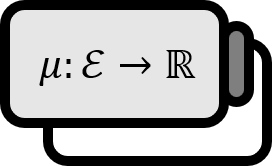
Sigma Algebra and Measurable Spaces
Definition
For a set $X \ne \varnothing$, a collection $\mathcal{E} \subset \mathscr{P} (X)$ satisfying the following conditions is called a sigma algebra or sigma field on $X$. $\mathscr{P} (X)$ is the power set of $X$.
- (i): $\varnothing \in \mathcal{E}$
- (ii): $E \in \mathcal{E} \implies E^{c} \in \mathcal{E}$
- (iii): $\displaystyle \left\{ E_{n} \right\}_{n \in \mathbb{N}} \subset \mathcal{E} \implies \bigcup_{n=1}^{\infty} E_{n} \in \mathcal{E}$
The ordered pair of the set $X$ and the sigma field $\mathcal{E}$, $(X , \mathcal{E})$, is called a measurable space.
Explanation
Although it is the same concept, in mathematics it is called a sigma algebra and in statistics a sigma field. $\sigma$ denotes countable, which is the meaning used in condition (iii) of the definition. For a sigma algebra $\mathcal{E}$, from (ii), (iii), and De Morgan’s laws the following holds.
$$ \left\{ E_{n} \right\}_{n \in \mathbb{N}} \subset \mathcal{E} \implies \bigcap_{n=1}^{\infty} E_{n} \in \mathcal{E} $$
If a measure $\mu$ is given, then $(X , \mathcal{E} , \mu)$ is called a measure space, and in particular if the measure $\mu$ is a probability measure it is called a probability space.
Carathéodory condition: If $E \subset \mathbb{R}$ satisfies $m^{ \ast }(A) = m^{ \ast } ( A \cap E ) + m^{ \ast } ( A \cap E^{c} )$ with respect to $A \subset \mathbb{R}$, then $E$ is called a measurable set, and is denoted as $E \in \mathcal{M}$.
As the name suggests, a ‘measurable set’ is a set whose length (or size) can be measured. By the countable subadditivity of the outer measure (see countable subadditivity of outer measure), $$m^{ \ast }(A) \le m^{ \ast } ( A \cap E ) + m^{ \ast } ( A \cap E^{c} )$$ is trivial, so verifying whether a set is measurable is essentially equivalent to checking $$m^{ \ast }(A) \ge m^{ \ast } ( A \cap E ) + m^{ \ast } ( A \cap E^{c} )$$ .
Purpose of the definition
As calling $(X, \mathcal{E})$ a measurable space suggests, the $\sigma$-algebra $\mathcal{E}$ is a systematic collection of those subsets to which we can assign sizes (length, area, volume, etc.). The development of measure theory has gone hand in hand with the development of probability theory, so it is often intuitively helpful to think of the size of a set as the probability that an event occurs.
First, it is obvious that we must be able to measure the set $X$ that we are interested in. Therefore, if we can measure the size of an arbitrary set $E \subset X$, we can measure the whole space, and hence we must be able to measure complements $E^{c}$. Conditions (ii) and (iii) of the definition are set to ensure these two prerequisites.
Also, if two sets $E_{1}, E_{2} \subset X$ are measurable, it is natural that their union $E_{1} \cup E_{2}$ should also be measurable. In analysis we frequently handle limits and convergence of sequences of functions (see limits and convergence of sequences of functions), and for that purpose the requirement of countable unions is necessary in the definition of a $\sigma$-algebra. Summarizing, the definition of a sigma algebra can be expressed in one line as follows.
- A collection $\mathcal{E}$ of subsets of $X$ is called a $\sigma$-algebra if it is closed under complements and countable unions.
Examples
For a set $X$,
The power set $\mathscr{P} (X)$ is a sigma algebra of $X$. In particular, it is the largest sigma algebra on $X$.
The set $\left\{ \varnothing, X \right\}$ is a sigma algebra of $X$, and it is the smallest sigma algebra.
An arbitrary intersection of sigma algebras is also a sigma algebra.
Sigma algebra of the collection of measurable sets
Given the above definition, the collection of measurable sets $\mathcal{M}$ of $X = \mathbb{R}$ forms a sigma algebra with the following properties.
$\mathcal{M}$ is a sigma algebra with the following properties.
- [1]: $$ \varnothing \in \mathcal{M} $$
- [2]: $$ E \in \mathcal{M} \implies E^{c} \in \mathcal{M} $$
- [3]: $$ \left\{ E_{n} \right\}_{n \in \mathbb{N}} \subset \mathcal{M} \implies \bigcup_{n=1}^{\infty} E_{n} \in \mathcal{M} $$
- [4]: $$ \left\{ E_{n} \right\}_{n \in \mathbb{N}} \subset \mathcal{M} \implies \bigcap_{n=1}^{\infty} E_{n} \in \mathcal{M} $$
- [5]: $$ \mathcal{N} \subset \mathcal{M} $$
- [6]: $$ \mathcal{I} \subset \mathcal{M} $$
- [7]: If we denote $E_{i} , E_{j} \in \mathcal{M}$, then the following holds. $$ E_{i} \cap E_{j} = \varnothing , \forall i \ne j \implies m^{ \ast } \left( \bigcup_{n=1}^{\infty} E_{n} \right) = \sum_{n = 1} ^{\infty} m^{ \ast } ( E_{n}) $$
- $\mathcal{I}$ is the collection of all intervals, and $\mathcal{N}$ is the collection of all null sets.
In particular, note that [7] is an essential property for the ‘generalization of length’ that Lebesgue envisaged in his dreams.