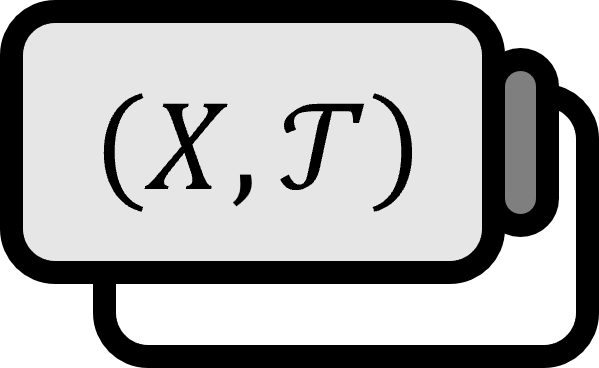
Basis and Local Basis in Topology
Definition
For a topological space $\left( X , \mathscr{T} \right)$, let $\mathscr{B} , \mathscr{B}_{x} \subset \mathscr{T}$.
- Let $B_{\lambda} \in \mathscr{B}$. If for every $U \in \mathscr{T}$ there exists an index set $\Lambda$ satisfying $$ U = \bigcup_{\lambda \in \Lambda} B_{ \lambda } $$ then $\mathscr{B}$ is called a basis for $\mathscr{T}$. In this case the topology $\mathscr{T}$ is said to be generated by $\mathscr{B}$.
- Let $x \in X$. If $x \in B$ for every $B \in \mathscr{B}_{x}$, and for every $U \in \mathscr{T}$ containing $x$ there exists a $B \in \mathscr{B}_{x}$ satisfying $$ x \in B \subset U $$ then $\mathscr{B}_{x}$ is called a local basis at $x$.
Explanation
Since the definition is written in a fairly confusing way, it will be much easier to accept it conceptually before working through the exercises. It only feels similar to the basis in linear algebra, and by definition there is little that is actually alike, so let us not strain ourselves trying to find a connection.
In a word, a basis is a collection of sets from which the given topology can be built by taking unions. Since there is no need to consider intersections, one only needs to gather the ‘small’ open sets in the topology to construct it.
Taking a metric space as an example, the set of all open balls becomes a basis of the metric space.
Necessity
From the standpoint of someone studying from a textbook, thinking of finding a basis $\mathscr{B}$ within a topology $\mathscr{T}$—as one did in linear algebra—makes the concept nothing but difficult and puzzling. Conversely, if you take the standpoint of generation, that is, of building a topology from a basis, there is nothing quite as convenient as a basis.
For example, suppose we build a topological space from sequences of natural numbers, and we want to construct the topology based on the first term. We can approach it by letting $B_{1}$ be the set of sequences whose first term is $1$, $B_{2}$ the set of sequences whose first term is $2$, $B_{k}$ the set of sequences whose first term is $k$, … and then regarding these as open sets. The problem is that the union $B_{1} \cup B_{2}$ does not exist in $\mathscr{T}$. This is because there is no sequence whose first term is either $1$ or $2$; in such a case, if we simply assume that every union that can be formed from $\mathscr{B} = \left\{ B_{k} \right\}_{k \in \mathbb{N}}$ exists, matters become much easier. This is precisely making good use of the topology generated by a basis.
Criterion 1
Criterion for a basis: For the universal set $X$, $\mathscr{B} \subset \mathscr{P} (X)$ is a basis of $X$ when it satisfies the following two conditions.
- (i): $\displaystyle X = \bigcup_{B \in \mathscr{B}} B$
- (ii): For all $ B_{1} , B_{2} \in \mathscr{B}$ with $x \in B_{1} \cap B_{2}$, there exists a $B_{x} \in \mathscr{B}$ satisfying the following. $$ x \in B_{x} \subset B_{1} \cap B_{2} $$
The criterion above is a theorem that can be usefully applied in actual problem solving and so on, so be sure to keep it in mind. Depending on the textbook, this criterion may instead serve as the definition.
Unlike a basis, which is a concept for the whole topology, a local basis is a concept that deals with only a single given point. It sounds long and difficult, but to summarize, in the end even gathering only the ‘smallest’ among all the open spaces containing $x$ satisfies the conditions of a local basis.
Taking a metric space as an example, the set of all open balls centered at $x$ becomes a local basis at $x$.
The Relationship Between Basis and Local Basis
Let $X$ be a topological space.
If $\mathscr{B}$ is a basis of $X$, then $\mathscr{B}_{x} := \left\{ B \in \mathscr{B} \ | \ x \in B \right\}$ is a local basis of $x \in X$. Conversely, if $\mathscr{B}_{x}$ is a local basis for every $x \in X$, then $\displaystyle \mathscr{B} := \bigcup_{x \in X} \mathscr{B}_{x}$ is a basis of $X$.
Note
Since this is not a necessary and sufficient condition, be careful that in order for the converse to hold, one must consider the local basis at every point.
Munkres. (2000). Topology(2nd Edition): p78. ↩︎