
Coulomb's Law
Law1
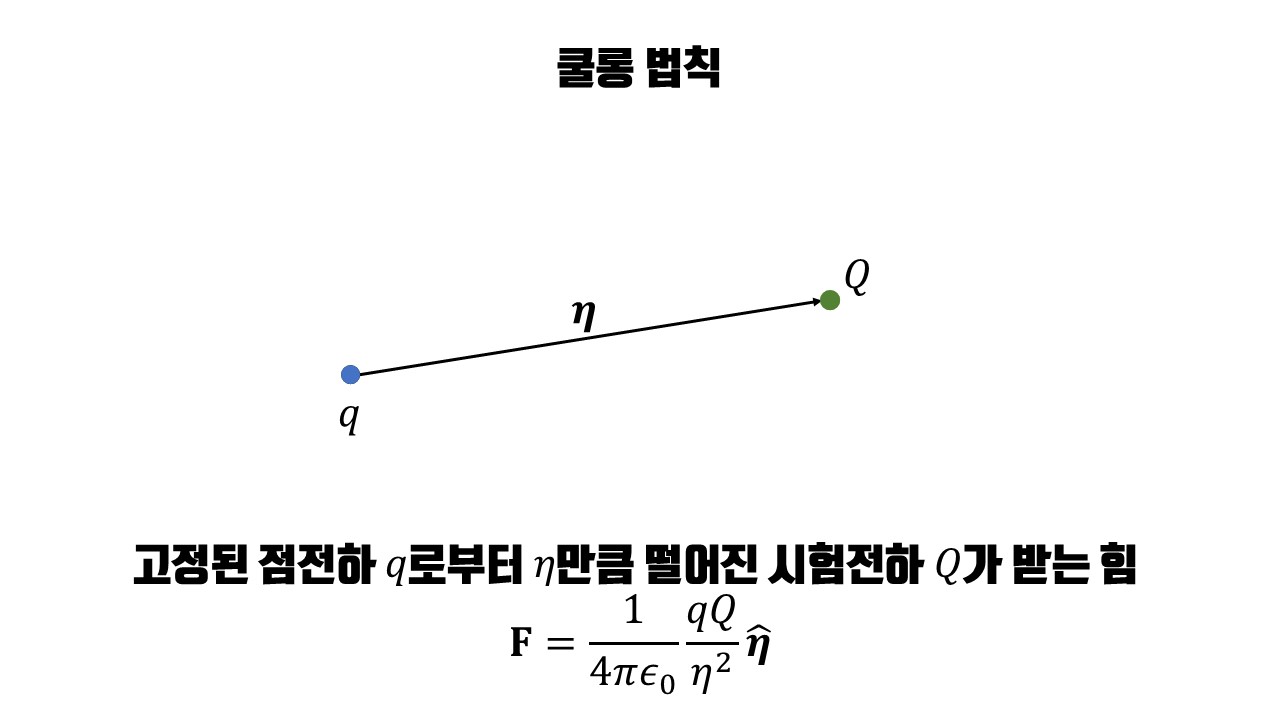
The force experienced by a test charge $Q$ located a distance $\cR$ from a fixed point charge $q$ is called the Coulomb force, and the formula is as follows.
$$ \mathbf{F} = \dfrac{1}{4\pi \epsilon_{0}} \dfrac{qQ}{\cR ^2} \crH \tag{1} $$
This is called Coulomb’s law.
Explanation
Coulomb’s law is an empirical law obtained from repeated experiments. Therefore it cannot be proved mathematically. It is analogous to an axiom in mathematics. $\epsilon_{0}$ is the permittivity of free space, and its value is $8.85 \times 10^{-12} \dfrac{\mathrm C^2}{\mathrm N \cdot \mathrm m^2}$.
Equation $(1)$ is expressed in the International System of Units. Expressed in the Gaussian system, it is as follows.
$$ \mathbf{F} = \dfrac{qQ}{\cR ^2} \crH $$
This replaces the preceding proportionality constant in the International System of Units with $1$. That is referred to as $\dfrac{1}{4\pi\epsilon_{0}} \equiv 1$. To convert the International System of Units to the Gaussian system, replace $\epsilon_{0}$ with $\dfrac{1}{4\pi}$.
David J. Griffiths, 기초전자기학(Introduction to Electrodynamics, 김진승 역)(4th Edition). 2014, p65-70 ↩︎