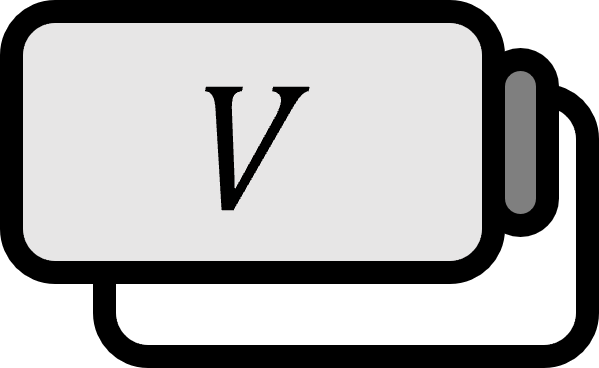
Direct Sum in Vector Spaces
Definition
vector space $V$의 two subspaces $W_{1}$ and $W_{2}$ satisfy the following, then $V$ is called the direct sum of $W_{1}$ and $W_{2}$, and is denoted as $V = W_{1} \oplus W_{2}$.
(i) Existence: For any $\mathbf{v} \in V$ there exist $\mathbf{v}_{1} \in W_{1}$ and $\mathbf{v}_{2} \in W_{2}$ satisfying $\mathbf{v} = \mathbf{v}_{1} + \mathbf{v}_{2}$.
(ii) Trivial intersection: $W_{1} \cap W_{2} = \left\{ \mathbf{0} \right\}$
(iii) Uniqueness: For a given $\mathbf{v}$ the $\mathbf{v}_{1} \in W_{1}$ and $\mathbf{v}_{2} \in W_{2}$ satisfying $\mathbf{v} = \mathbf{v}_{1} + \mathbf{v}_{2}$ are unique.
Generalization1
Let $W_{1}, W_{2}, \dots, W_{k}$ be subspaces of the vector space $V$. If these subspaces satisfy the following conditions, we say that $V$ is the direct sum of $W_{1}, \dots, W_{k}$ and denote it by $V = W_{1} \oplus \cdots \oplus W_{k}$.
$\displaystyle V = \sum\limits_{i=1}^{k}W_{i}$
$\displaystyle W_{j} \bigcap \sum\limits_{i \ne j}W_{i} = \left\{ \mathbf{0} \right\} \text{ for each } j(1\le j \le k)$
In this case $\sum\limits_{i=1}^{k}W_{i}$ is the sum of $W_{i}$.
Explanation
(i) Existence: This condition is $V = W_{1} + W_{2}$; in other words it can be rewritten as “$V$ is the sum of $W_{1}$ and $W_{2}$.”
(iii) Uniqueness: In fact this condition is redundant. If (ii) holds and $\mathbf{v}_{1} \in W_{1}$, then $\pm \mathbf{v}_{1} \notin W_{2}$, and for the zero vector $\mathbf{0}$ of $W$ there exists only the following representation.
$$ \mathbf{0} = \mathbf{0} + \mathbf{0},\quad \mathbf{0}\in W_{1}, W_{2} $$
Therefore, if for $\mathbf{v}$ there exist two representations $\mathbf{v}_{1} + \mathbf{v}_{2}$ and $\mathbf{v}_{1}^{\prime} + \mathbf{v}_{2}^{\prime}$,
$$ \mathbf{0} = \mathbf{v} - \mathbf{v} = (\mathbf{v}_{1} - \mathbf{v}_{1}^{\prime}) + (\mathbf{v}_{2} - \mathbf{v}_{2}^{\prime}) = \mathbf{0} + \mathbf{0} \implies \mathbf{v}_{1}=\mathbf{v}_{1}^{\prime},\ \mathbf{v}_{2}=\mathbf{v}_{2}^{\prime} $$
furthermore (i), (ii) $\iff$ (iii) hold.
From the definition alone it may be hard to get an intuition, but examples in Euclidean space show that the concept is quite natural and convenient. For example, consider $\mathbb{R}^{3} = \mathbb{R} \times \mathbb{R} \times \mathbb{R}$. An element of $\mathbb{R}^{3}$ is a $3$-dimensional vector ▷eq41◯; separate it into ▷eq42◯ and ▷eq43◯.
On the other hand, when reconsidering the process of recombining the separated pieces, since ▷eq44◯ and ▷eq45◯, their naive simple sum set ▷eq46◯ has elements consisting of scalars and ▷eq47◯-dimensional vectors. With only such symbols it is difficult to express the actual expansions and separations of the spaces we want. Therefore introducing the concept of direct sum makes it easier in many ways to describe when subspaces partition a vector space well.
Construction
In the definition we described the direct sum from the viewpoint of decomposing a given vector space into a sum of subspaces. Conversely, one can construct a new vector space using the direct sum of two vector spaces. For two ▷eq48◯ vector spaces ▷eq01◯ and ▷eq32◯, on the direct sum ▷eq51◯ define the addition and scalar multiplication as follows. For ▷eq52◯, ▷eq53◯, ▷eq54◯,
$$ (v_{1}, w_{1}) + (v_{2}, w_{2}) = (v_{1}+v_{2}, w_{1}+w_{2}) $$
$$ \alpha (v, w) = (\alpha v, \alpha w) $$
With these definitions, ▷eq51◯ satisfies the axioms of a vector space and thus is a vector space.
See also
Stephen H. Friedberg, Linear Algebra (4th Edition, 2002), p275 ↩︎