Definition of a Tipping Point in Dynamics
Definition 1
The dynamical changes that occur in a normal system as parameters vary are called bifurcations, whereas the dynamical changes that occur in non-normal systems are called tipping points.
Explanation
Typical tipping
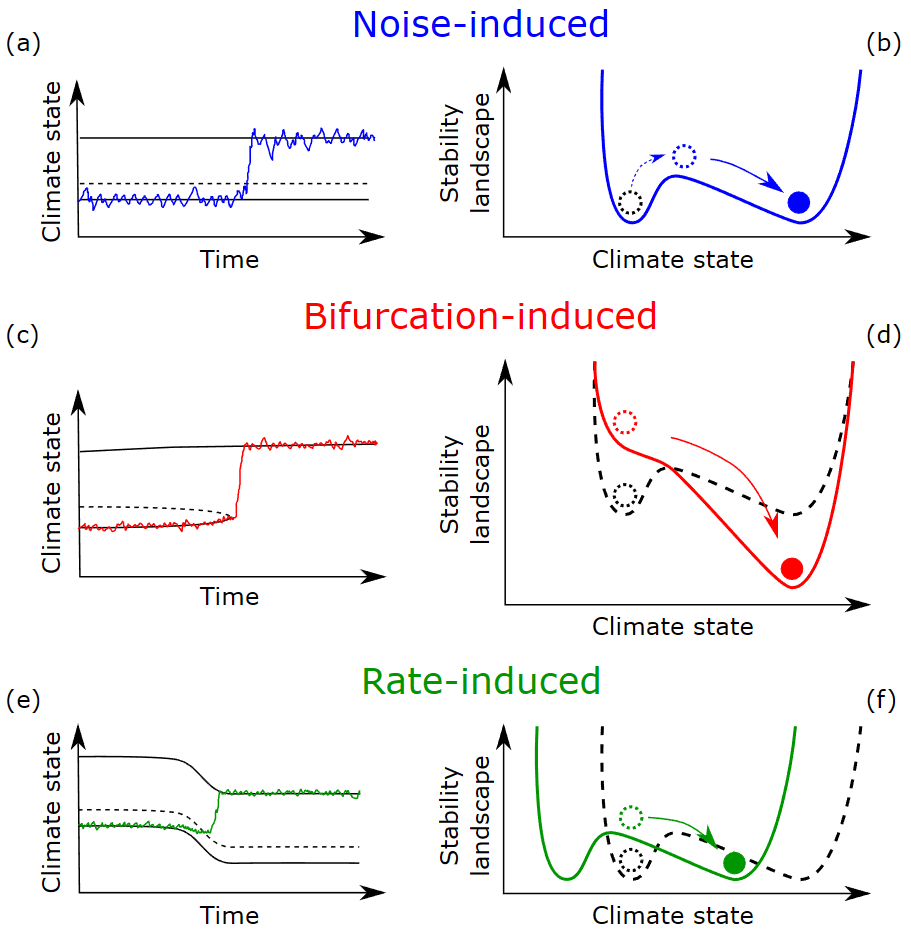
There can be several types of tipping points, but as of 2026 three are widely recognized: N-tipping, B-tipping, and R-tipping. Each will be treated in more detail in its own post, but from the perspective of the quasi-static attractor they can be briefly summarized as follows3.
- N-tipping: The system parameters do not change, but the state is shifted by noise occurring in the neighborhood of the quasi-static attractor. It is more likely to occur when the noise is stronger.
- B-tipping: Caused by a bifurcation of the quasi-static attractor due to a sudden or qualitative change in the system. In the figure above this is illustrated by a saddle–node bifurcation occurring over time, where a stable fixed point disappears and the state rapidly transitions to another fixed point.
- R-tipping: From the viewpoint of topological equivalence of systems, the system itself has not changed, but in a normal system the rate of change of the state is also time-dependent. R-tipping occurs when the system’s change is so rapid that, despite varying continuously, the trajectory fails to keep up with the quasi-static attractor.
Less well-known tipping
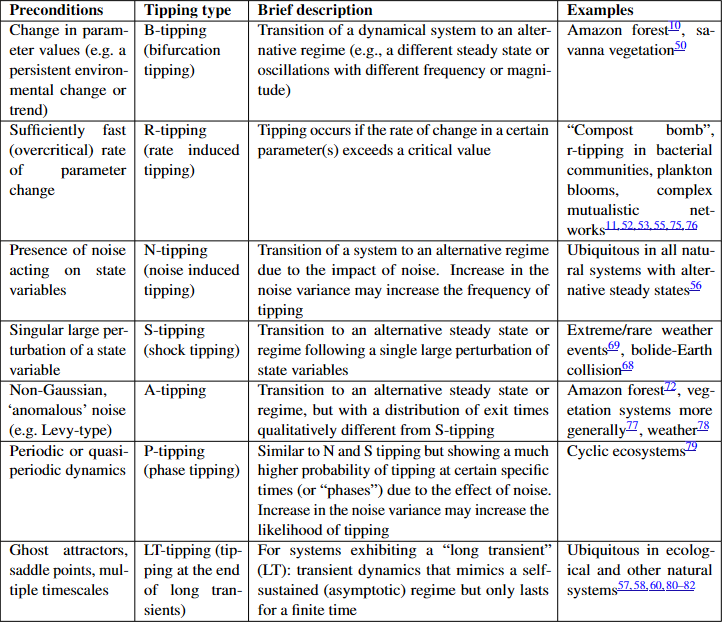
Other types such as S-tipping, A-tipping, and P-tipping have also been proposed, so they are worth being aware of4.
Patel, D., & Ott, E. (2023). Using machine learning to anticipate tipping points and extrapolate to post-tipping dynamics of non-stationary dynamical systems. Chaos: An Interdisciplinary Journal of Nonlinear Science, 33(2). https://doi.org/10.1063/5.0131787 ↩︎
https://en.wikipedia.org/wiki/File:IPCC_schematic_wikipedia.pdf ↩︎
Peter Ashwin, Sebastian Wieczorek, Renato Vitolo, Peter Cox; Tipping points in open systems: bifurcation, noise-induced and rate-dependent examples in the climate system. Philos Trans A Math Phys Eng Sci 13 March 2012; 370 (1962): 1166–1184. https://doi.org/10.1098/rsta.2011.0306 ↩︎
Hastings, A., Petrovskii, S., Lucarini, V., & Morozov, A. (2026). Tipping points in complex ecological systems. https://doi.org/10.48550/arXiv.2602.20702 ↩︎