Open Dynamical Systems and Stationarity
Definition 1 2
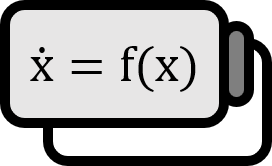
- If there exist external factors $\lambda$ that influence the system $\dot{x} = f (x)$ and can change the fate of a trajectory, the system is called an open system.
- If an open system is independent of time $t$, it is called stationary; if it depends on time as in $\dot{x} = f \left( x , \lambda (t) \right)$ and satisfies $\lambda = \lambda (t)$, it is called non-stationary.
Explanation
In stationary systems, the dynamical changes that occur as parameters vary are called bifurcations, whereas the dynamical changes that occur in non-stationary systems are called tipping points.
Ashwin, P., Wieczorek, S., Vitolo, R., & Cox, P. (2012). Tipping points in open systems: bifurcation, noise-induced and rate-dependent examples in the climate system. Philosophical Transactions of the Royal Society A: Mathematical, Physical and Engineering Sciences, 370(1962), 1166-1184. ↩︎
Patel, D., & Ott, E. (2023). Using machine learning to anticipate tipping points and extrapolate to post-tipping dynamics of non-stationary dynamical systems. Chaos: An Interdisciplinary Journal of Nonlinear Science, 33(2). https://doi.org/10.1063/5.0131787 ↩︎